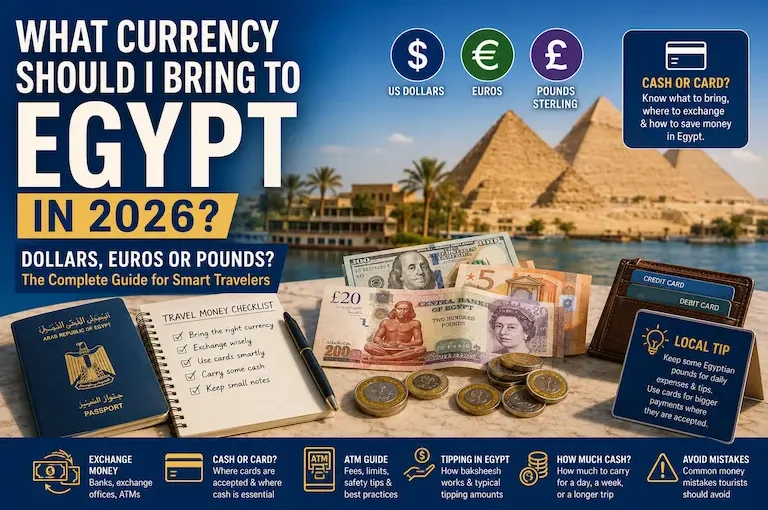
What's Inside This Guide
Dollars, Euros or Pounds?
Quick answer:
All three work well in Egypt, so bring whichever you can get hold of most easily at home without paying over the odds for it. US dollars are particularly widely recognised in tourism, but Egyptian pounds are the practical currency for everyday spending and most tips. What actually matters more than which currency you choose is where you change it, which we’ll get to below.
What currency should I bring?
If you’re coming from the UK, pounds sterling are fine to bring and exchange once you’re in Egypt, and the same goes for euros from the eurozone. US dollars are still the default recommendation in most guides, mainly because they’re the currency Egyptian bank counters and tour operators are most used to handling, particularly for things like the visa on arrival fee. In practice, though, you don’t need to convert your home currency into dollars before you fly. That extra step usually costs you money in fees and a worse rate, for no real benefit once you’re on the ground.
Avoid turning up with notes that are old, torn or heavily marked. Egyptian banks and exchange offices can be fussy about the condition of foreign notes, so bring clean, newer bills where you can.
🇬🇧 Our local tip for UK travellers Don’t automatically convert your pounds into US dollars before travelling just because you’re visiting Egypt. If you can bring GBP and exchange it through a reliable channel in Egypt at a competitive rate, an extra GBP to USD to EGP conversion may simply add another layer of cost.
Can you pay in USD, EUR or GBP directly?
Sometimes, but don’t rely on it. Larger hotels, Nile cruise operators and some tour companies will quote prices in dollars or euros and happily accept them in cash. Entrance fees at major sites are priced in EGP with a rough foreign-currency equivalent posted alongside. Outside hotels and tourist-oriented businesses, you’ll generally need Egyptian pounds for shops, local restaurants, taxis and markets.
Where should tourists exchange money?
You have three sensible options: banks, licensed exchange offices (often called a sarraf), and ATMs. All three are safer and more reliable than exchanging with anyone on the street, however good a rate they offer.
We regularly hear from UK clients who compare the exchange rate they were offered at home with what they received after arriving in Egypt, and the difference can sometimes be significant. It’s worth checking the live mid-market rate online before you travel and comparing it with whatever your local bank or airport kiosk is offering, so you can judge for yourself whether it’s a fair deal.
ATMs in Egypt
ATMs are widely available in Cairo, Hurghada, Sharm El Sheikh, Luxor and other tourist areas, including inside airports, hotels and shopping centres. Foreign-issued Visa and Mastercard cards are widely accepted at ATMs in tourist areas, although availability and fees can vary by bank and card issuer.
Check your bank’s travel policy before you fly. Some banks may ask you to notify them about overseas card use, while others don’t require a travel notification. Either way, it’s worth checking your card is enabled for international transactions and confirming the fees for foreign purchases and cash withdrawals.
Fees can come from more than one place: your own bank, and the Egyptian ATM itself. Check both your own bank’s fees and any fee displayed by the Egyptian ATM before confirming the withdrawal.
Our local tip Not all currency exchange machines offer the same deal. We recently used a Banque Misr machine in Dahar and got a very good exchange rate with no commission. On another occasion, an Euronet machine in Hadaba charged us 10% commission for exchanging currency. Always check the rate and total fees before accepting an exchange..
Cash or card?
Both, realistically. Cards are accepted at hotels, larger restaurants, malls and most tour operators, and contactless payment has become common in these settings. Cash is what you’ll need for taxis, local restaurants, markets, tipping and smaller purchases, particularly outside the main resort areas. Treat your card as the way you’ll cover the bigger expenses of your trip, and cash as what handles the day-to-day.
How much cash should you carry?
There’s no single amount that works for everyone, since it depends on how you travel, where you eat and how much you tip. For small everyday expenses, keeping a few hundred Egyptian pounds in smaller notes is a practical starting point. Top up your cash as needed rather than carrying your entire holiday budget, and lean on your card for larger purchases where it’s accepted.
Tipping in Egypt
Tipping, known locally as baksheesh, is a genuine part of how many people in Egypt’s tourism industry earn their income, and it’s expected in a wider range of situations than tourists from some countries are used to. That said, it doesn’t need to feel like everyone has their hand out. A modest tip for a bag carried, a table served, a bathroom attendant or a driver who’s helped you is appreciated and normal. For everyday tips, Egyptian pounds are usually the most practical choice, so it’s worth keeping some small notes on you rather than relying entirely on a card.
Common money mistakes tourists make
- Exchanging a large amount with an unofficial street trader. Stick to banks or licensed exchange offices.
- Relying on a card alone. Plenty of everyday situations, especially outside hotels and resorts, still run on cash only.
- Not keeping small notes on hand. Large notes can be hard for taxi drivers, small shops and market stalls to break.
- Paying in your home currency at the card machine. Choosing EGP generally avoids the less favourable DCC rate.
- Exchanging money before leaving home without checking the rate. Compare it against the mid-market rate first, since it’s sometimes a worse deal.
Our local tip You don’t need to carry your entire holiday budget in cash. Keep enough Egyptian pounds with you for small daily expenses, tips, local purchases and places where card payment may not be available. For larger expenses, using a card can be more convenient and safer than carrying a large amount of cash.
FAQ
Should I bring dollars, euros or pounds sterling to Egypt?
Whichever you can obtain most easily and cheaply at home. All three exchange well in Egypt. There is usually no need to convert your home currency into dollars before you travel.
Can I pay in euros or dollars in shops and restaurants?
Sometimes at hotels and larger tourist businesses, but most everyday spending, particularly outside resorts, is in Egyptian pounds.
Is it better to exchange money at home or in Egypt?
Compare the actual rate and fees first. Many travellers find that exchanging through a reputable bank or licensed exchange provider in Egypt can be competitive, but the best option depends on the rates and fees available to you.
Do foreign cards work at Egyptian ATMs?
Foreign-issued Visa and Mastercard cards are widely accepted at ATMs in tourist areas, although availability and fees can vary by bank and card issuer.
Should I tell my bank I’m travelling to Egypt?
Check your bank’s policy before you travel. Some banks may ask you to notify them about overseas card use, while others no longer require a travel notification. Either way, make sure your card is enabled for international transactions and check the fees for foreign purchases and ATM withdrawals.
Is it safe to use an ATM on the street in Egypt?
ATMs are widely available, but when possible, use machines operated by established banks or located inside banks, hotels, shopping centres or airports. Avoid unfamiliar standalone machines if you have a safer alternative, and always check the screen carefully before accepting any conversion or fee.
How much cash should I bring to Egypt for a week?
There is no single amount that works for everyone. A good strategy is to keep a modest amount of EGP for everyday expenses and use your card for larger purchases where accepted. You can withdraw or exchange more as needed.
Should I tip in Egyptian pounds or foreign currency?
For everyday tips, Egyptian pounds are usually the most practical choice.
Is tipping expected in Egypt?
Yes, in more situations than many tourists are used to, though it doesn’t need to be excessive. Small, consistent tips for everyday services are the norm.