
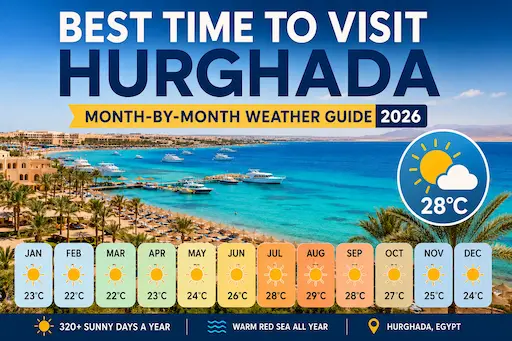
Book Hurghada in the wrong month and you’ll either face 38°C summer heat or chilly Red Sea winds. Book it in the right month and you’ll get warm seas, perfect snorkeling, and lower prices.
Hurghada has over 320 sunny days a year, almost no rain, and a Red Sea that stays swimmable in every month of the calendar. The difference between a good month and a great month, though, is real — and it shows up in sea temperature, crowd levels, and hotel rates.
Summer air temperatures push past 36°C. Winter nights can drop to 11°C. The sea ranges from 22°C in February to 28.6°C in August. This guide cuts through the noise so you know exactly when to book — and what to expect when you arrive.
About this guide: since 2010 the team at Luxe Tours Egypt has been guiding travelers across Hurghada and the Red Sea throughout every season of the year. The recommendations in this guide combine firsthand local experience with verified climate data from WeatherSpark, Weather Atlas, and seatemperature.org (NOAA satellite data).
What's Inside This Guide
Quick Answer: Best Time to Visit Hurghada by Goal
If you’re looking for the short answer: October and November are generally the best months to visit Hurghada. The sea stays warm after summer, daytime temperatures are comfortable, and conditions are ideal for beaches, snorkeling, diving, and sightseeing. For the best time to visit Hurghada on a budget, May and September offer the best value. The best season to visit Hurghada overall is autumn — but every traveler’s answer is different.
| Travel Goal | Best Month |
| Overall Best Time | October |
| Best Weather | November |
| Best for Families | April |
| Best for Snorkeling | October |
| Best for Diving | November |
| Best for Budget Travelers | May – September |
| Best for Warm Sea | August |
| Best for Desert Safari | March |
| Best for Kitesurfing | July |
| Escaping European Winter | January |
Quick Reference: Hurghada Weather by Month
Sea temperature data: seatemperature.org (NOAA satellite).
Air temperature: WeatherSpark + Weather Atlas.
| Month | High °C | Low °C | Sea °C | Crowds | Best For |
| January | 21 | 11 | 23.0 | Low | Escaping European winter, sightseeing |
| February | 23 | 11 | 22.2 | Low | Diving visibility, budget beach |
| March | 25 | 14 | 22.3 | Moderate | Desert safaris, sightseeing |
| April | 29 | 17 | 22.9 | Moderate | Families, all-round ideal |
| May | 33 | 22 | 24.4 | Moderate | Budget summer holidays |
| June | 35 | 24 | 26.1 | Moderate–High | Budget summer holidays |
| July | 37 | 26 | 28.1 | Very High | Family summer holidays |
| August | 38 | 26 | 28.6 | Very High | Warm sea and beach days |
| September | 34 | 24 | 27.6 | Moderate–High | Value + warm water |
| October | 31 | 20 | 27.2 | Moderate | Sweet spot — warm sea, mild air |
| November | 27 | 15 | 25.4 | Moderate | Best all-round month |
| December | 22 | 11 | 24.2 | High | Winter sun, sightseeing |
Hurghada Climate: The Basics
The Hurghada climate is BWh — hot desert. Annual rainfall averages around 6mm, spread across maybe two wet days per year. The wettest month is October, with around 2mm. What changes month to month isn’t rain. It’s heat, wind, and sea temperature.
Winter (December–February): Warm, sunny days at 20–23°C. Nights drop to 11°C — cold by Egyptian standards and noticeably colder on the water. Ideal for sightseeing and day trips. Not the month for a hot beach holiday.
Spring (March–May): Conditions improve steadily. March suits desert safaris and active trips. April is near-perfect. May is underrated — warm sea, thinner crowds, lower prices.
Summer (June–September): Air temperatures hit 35–36°C daily. The sea reaches its warmest — 26–29°C. European visitor numbers drop in June and early July, then rise again in August when school holidays begin. Wind is strong and consistent, driving a busy kitesurfing season.
Autumn (October–November): The best season for most travelers. Summer heat has cleared, the sea is still warm, and conditions are ideal from beach to desert.
Month-by-Month Breakdown
January
Air: 21°C high / 11°C low | Sea: 23.0°C avg (min 21.4°C)
Daytime temperatures are comfortable for sightseeing and beach walks. Evenings are cold; a fleece or light jacket is non-negotiable.
The sea at 21–23°C is swimmable, but it will feel cold to anyone not used to northern European beaches. Snorkelers will want a thin wetsuit for extended sessions. Underwater visibility, however, is excellent — January sits in the heart of the peak clarity window (November–April).
Best for: Winter sun, Luxor and Cairo day trips, diving for visibility.
Skip if: You want a hot beach holiday.
| January boat trips on the Red Sea can feel cold once you’re wet — sea spray combined with 11°C nights catches visitors off guard. Bring a windproof layer for any morning excursion. |
February
Air: 23°C high / 11°C low | Sea: 22.2°C avg (min 21.3°C) — coldest month for sea
February has the coldest sea temperatures of the year. The trade-off is exceptional underwater visibility — often 25–30 meters. Hotels sit in a between-peak period, with room to negotiate on rates.
Best for: Diving, budget travelers booking mid-February after Valentine’s peak.
Skip if: You need warm water for swimming.
| Serious divers know that February is when the Red Sea around Hurghada is at its clearest. |
March
Air: 25°C high / 14°C low | Sea: 22.3°C avg
March is transitional. Days warm up noticeably, and the khamsin (a dusty desert wind) can bring hazy days — brief, usually over within 24 hours. The sea stays around 22°C, similar to February.
Best for: Desert safaris, sightseeing day trips, walking tours.
Watch out for: Occasional khamsin events mid-March to mid-April.
| The khamsin is overstated in most travel guides. In a typical March you might see one or two dusty days. It’s not a reason to avoid March — just something to factor in. |
April
Air: 29°C high / 17°C low | Sea: 22.9°C avg
April is one of the best months to visit Hurghada. Warm enough to feel like a real holiday, not hot enough to be oppressive. Easter falls here most years, pushing hotel prices up — book well in advance.
The sea sits at 22–23°C, on the cooler side for swimming but clear and calm for snorkeling. Visibility is still in the peak winter window.
Best for: Families, first-time visitors, Luxor and Cairo day trips.
Watch out for: Easter price spikes. Book popular excursions 3–4 weeks ahead minimum.
| April is one of the busiest months for German and British families. Private guides for Luxor and Cairo day trips book up faster than most visitors expect. |
May
Air: 33°C high / 22°C low | Sea: 24.4°C avg
May is underrated. The sea has warmed past its winter cold, Easter crowds have cleared, and prices drop. Days are hot but manageable — morning boat trips are comfortable; afternoons belong to the beach or pool.
Best for: Budget travelers, couples without school-age children, water sports.
| May is consistently underbooked relative to how good it is. The sea is comfortable, hotels are negotiable, and the crowds from Easter have thinned. Anyone with flexible dates should take a serious look at May. |
June
Air: 35°C high / 24°C low | Sea: 26.1°C avg
Summer starts properly in June. Temperatures cross 35°C regularly. The sea at 26°C feels refreshing after a hot afternoon on the beach. Consistent northerly winds keep kitesurfing schools running full schedules.
Egypt applies daylight saving time from late April through late October, which means longer evenings and more usable beach time after 5pm.
| June gives kitesurfers reliable wind without the busier crowds of July and August. If the sport is your priority, June often works better than peak summer. |
July
Air: 37°C high / 26°C low | Sea: 28.1°C avg
July is the hottest month. The sea reaches 28°C — comfortable for long swims without any thermal protection. Wind is strong and consistent. Egyptian domestic tourism peaks too, with families from Cairo and Alexandria filling resort hotels alongside European visitors.
Plan outdoor activities early — before 10am or after 5pm. Daylight saving time extends evenings through October, so there’s more usable outdoor time in the cooler hours after 5pm than the clock might suggest.
Best for: Family summer holidays, warmest sea.
Skip if: You have elderly travelers or anyone who struggles with heat.
| July is noticeably busier than June. The combination of Egyptian school holidays and European summer travel pushes resort areas to their liveliest. If you prefer quiet, June or September is a better call. |
August
Air: 38°C high / 26°C low | Sea: 28.6°C avg — warmest of the year
Same heat profile as July. August has the warmest Red Sea of the year at 28.6°C. European school holidays — German, Polish, and British — overlap, making this one of the busiest months despite the heat.
Best for: Warm sea and beach days, diving without a wetsuit, family summer holidays.
Watch out for: Higher prices than June–July. Book hotels and excursions 6–8 weeks ahead.
| For snorkeling trips to Giftun Island — Orange Bay, Mahmya, Paradise Beach — August works well for water temperature, but boats fill up fast. Book early or go mid-week. |
September
Air: 34°C high / 24°C low | Sea: 27.6°C avg
September gets overlooked. Summer crowds have thinned, but the sea holds 27–28°C from months of accumulated heat. Temperatures have started to ease from August. Good value, warm water, quieter beaches.
Best for: Value seekers, diving, snorkeling.
| September is one of the best months for Giftun Island snorkeling day trips. The water is warm, the summer wind is calming down, and boats are noticeably less crowded than August. |
Best Boat Trips in Hurghada 2026 – Islands, Snorkeling & Private Yachts
October
Air: 31°C high / 20°C low | Sea: 27.2°C avg
October is when Hurghada gets busy again — and for good reason. The air is comfortably warm without summer heat, and the sea still holds 27°C from months of sun. It’s the most popular month for European visitors, particularly families and retirees.
Book accommodation and all guided excursions well ahead. October fills up.
Best for: Families, older travelers, first-time visitors, combining beach with sightseeing.
| October is when conditions for desert safaris are close to perfect — warm enough to enjoy, cool enough for an evening quad bike ride. The desert at sunset in October is worth planning your whole evening around. |
November
Air: 27°C high / 15°C low | Sea: 25.4°C avg
Most experienced Hurghada visitors consider November the best month of the year. The air is warm without summer heat, the sea is still 25°C, and the light is softer. Evenings need a layer, but days are ideal across the board — beach, diving, desert safari, Luxor day trip.
Best for: Everything. The most balanced month on the calendar.
| November is the month we recommend most consistently to first-time visitors. The combination of warm sea, mild air, good photography light, and calm conditions for boat trips puts it ahead of every other month. |
December
Air: 22°C high / 11°C low | Sea: 24.2°C avg
December brings the Christmas and New Year rush. Prices spike significantly in the final two weeks. Days are warm and sunny; evenings are cold. The sea at 24°C is swimmable for most people.
Best for: Christmas winter sun, sightseeing, Luxor and Cairo day trips.
Watch out for: Christmas week is the most expensive period of the year.
| Early December (1st–20th) is a genuine sweet spot — peak-season weather without Christmas-week pricing. Flexible travelers who avoid the last ten days of December will notice it in both price and crowd levels. |
Best Time for Snorkeling and Diving
The Red Sea around Hurghada has healthy coral year-round. What changes month to month is water temperature and visibility.
Best underwater visibility: November–April. Cooler water holds less plankton — often 20–30 meters. January and February sit at the heart of this window. Professional underwater photographers typically visit in winter.
Best water temperature for diving: July–October (27–29°C). No wetsuit needed; comfortable for long bottom times.
Practical note: At 22°C (February–March), most divers will want at least a 3mm wetsuit for multiple dives per day. At 28°C (August), a swimsuit is enough.
For private guided snorkeling trips to Giftun Island — including Orange Bay, Mahmya, and Paradise Beach — check availability with Luxe Tours Egypt.
Best Time for Sightseeing (Luxor and Cairo Day Trips)
Hurghada is a common base for day trips to Luxor (roughly 200km via the desert highway) and Cairo (around 500km, or a short flight). Weather matters more for these trips than most people expect.
Best months for Luxor day trips: October–April. Temperatures in Luxor run 5–8°C hotter than Hurghada in summer. In July, Luxor regularly hits 43°C. In November, it’s a comfortable 28°C.
Best months for Cairo day trips: October–May. Cairo winters are cool and clear. Summer is hot and hazy.
Months to avoid for sightseeing: June–August. Sites like Karnak Temple and the Pyramids Plateau are fully exposed with little shade. If you go in summer, start before 7am.
Best Time by Traveler Type
Families with young children: October, November, April.
Budget travelers: May, June, September.
Divers: November–April for visibility. July–October for warm water.
Sightseeing-focused trips: October–March.
Escaping European winter: December–February.
Couples / honeymoon: November. Weather, sea, light, and atmosphere all align.
| Planning a trip to Hurghada this year? See our most popular private excursions: Luxor Day Trip | Cairo Day Trip | Orange Bay Snorkeling | Desert Safari No shopping stops. No hidden fees. No Crowds. No Compromises. |
Quick Packing Tips for Hurghada by Season
Winter (December–February)
- Light jacket or fleece for evenings — non-negotiable
- Layers you can remove during the day
- Sunscreen (UV index is high even in January)
- Thin wetsuit or rash guard for extended snorkeling
Spring (March–May)
- Light clothes, one warm layer for cool March evenings
- Sun hat, sunglasses, sunscreen
- Reef-safe sunscreen for snorkeling
- Comfortable walking shoes for sightseeing
Summer (June–September)
- Lightweight, breathable clothing
- High-SPF sunscreen — daily
- Refillable water bottle
- Swim gear (no wetsuit needed)
- Electrolyte tablets if you’re active in the heat
Autumn (October–November)
- Mostly summer clothes, one light jacket for November evenings
- Reef-safe sunscreen
- Underwater camera — visibility is excellent
Data Sources
All temperature data in this guide comes from verified primary sources:
- Air temperature: WeatherSpark and Weather Atlas
- Sea temperature: seatemperature.org (NOAA satellite, multi-year averages)
- Precipitation/humidity: Climate-Data.org
Plan Your Trip
For a private guided experience from Hurghada — no shopping stops, no group buses:
- Things to Do in Hurghada →
- Is Hurghada Safe? →
- Hurghada Desert Safari →
- Hurghada Snorkeling Guide →
- Best Boat Trips in Hurghada →
- Hurghada to Luxor Day Trip →
- Hurghada to Cairo Day Trip →
- Dolphin House Hurghada →
| Book a Private Tour Questions about timing your visit? WhatsApp the Luxe Tours Egypt team at +20 127 644 1147 — we’re based in Hurghada and can advise based on your exact travel dates. |
Frequently Asked Questions (FAQs)
What is the best month to visit Hurghada?
October and November are the most consistently recommended months. The summer heat has cleared, the sea stays at 25–27°C, and conditions are ideal for beaches, snorkeling, diving, and sightseeing. April is the best spring option for families and first-time visitors
What is the best season to visit Hurghada?
Autumn — October and November — is the best season overall. The combination of warm sea, comfortable air temperatures, and calm conditions makes it the most balanced time of year. Spring (April–May) is a strong second choice, with lower prices and thinner crowds.
Is Hurghada good in winter?
Yes, with realistic expectations. January and February offer warm, sunny days (20–23°C) — ideal for sightseeing, Luxor and Cairo day trips, and escaping European winter. Evenings are cold (11°C). The sea is swimmable at 22–23°C but on the cool side.
Is Hurghada warm enough to swim in January?
The sea in January averages 23°C, which most people find swimmable for short sessions. For extended snorkeling or multiple dives, a rash guard or thin wetsuit makes a real difference. Wind chill on boat trips adds to the cold sensation, especially in the morning.
Can you swim in Hurghada all year round?
Yes. The Red Sea around Hurghada never drops below 21°C, so it stays swimmable every month. At 22°C (February–March), extended sessions will feel cold to many people — a thin wetsuit helps. At 28°C (August), the water is warm enough for hours without any protection.
What is the water temperature in Hurghada?
Sea temperatures range from 22.2°C in February to 28.6°C in August. From July through October, the Red Sea stays above 27°C. Source: seatemperature.org, NOAA satellite data.
What is the hottest month in Hurghada?
July and August are the hottest months, with daytime highs around 36 – 38°C and overnight temperatures staying at 26°C. Both months also see the strongest winds.
Is Hurghada too hot in summer?
It depends on your tolerance. At 35–36°C, midday hours are uncomfortable for outdoor activity. Early mornings and evenings are fine. Most summer visitors structure their days around beach and pool time from late morning through afternoon, with excursions either early or after 5pm. Families with young children or elderly travelers tend to find summer harder going.
Is Hurghada crowded in summer?
June and early July are quieter than peak season. From mid-July through August, European school holidays push crowds back up — particularly families from Germany, Poland, and the UK. September drops off again.
When is the best time for snorkeling in Hurghada?
For warm water (no wetsuit): July–October (27–29°C). For clearest visibility: November–April (often 20–30 meters). October hits both — warm sea and still-good visibility — which is why it’s the top recommendation for snorkeling.
When does Hurghada get windy?
June through September sees the strongest winds — consistent northerlies of 18–25 knots. Winter winds are lighter and less predictable. April can bring occasional khamsin events.
Is Hurghada hot in April?
April is warm rather than hot — highs around 29°C, lows around 17°C. One of the most comfortable months for outdoor activities. Easter week brings higher prices and more visitors.
What should I pack for Hurghada?
Year-round: high-SPF sunscreen, sunglasses, sun hat. Add a light jacket for October–March evenings. In summer, prioritize lightweight breathable clothing and a refillable water bottle. A rash guard is worth packing for any snorkeling-heavy trip.
About the Author
This guide was written by the team at Luxe Tours Egypt, a private tour company based in Hurghada and Cairo, Egypt. We run private, no-shopping-stop tours year-round and have direct firsthand experience of how conditions change across every month of the year on the Red Sea coast.
We do not accept paid placements or sponsored content. All recommendations in this guide reflect our own operational experience and independently verified data.
WhatsApp: +20 127 644 1147