The Complete Guide to Egypt’s Oldest Christian Neighborhood
What's Inside This Guide
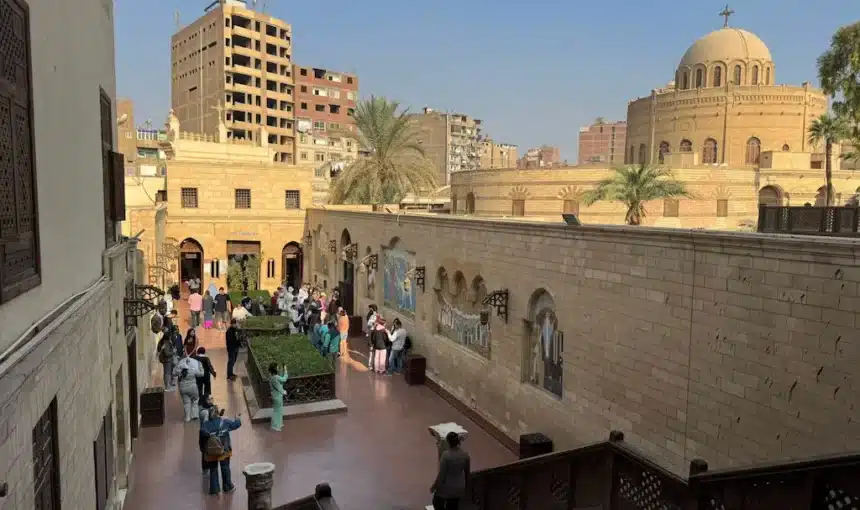
There is a part of Cairo that most visitors never find. It sits tucked behind a Metro station, surrounded by ancient walls, accessed through a gateway that opens onto a world that feels entirely separate from the roaring, honking, magnificent chaos of the city around it.
This is Coptic Cairo — also called Old Cairo or Mar Girgis — and it is one of the most quietly extraordinary places in all of Egypt.
While the Pyramids of Giza command the western horizon and the mosques of Islamic Cairo define the city’s medieval skyline, Coptic Cairo holds something older and perhaps more unexpected: the living remnants of a Christian community that has called Egypt home since the first century AD. The Coptic Orthodox Church was established here, in Egypt, nearly 2,000 years ago — centuries before Christianity reached most of Europe. These streets, these churches, these crumbling Roman walls have been the heartbeat of that community ever since.
There are churches here that were already ancient when the great medieval mosques of Cairo were being built. There is a synagogue that contains one of the most famous stories in the entire Bible. There is a cave church beneath a Roman fortress where, according to tradition, the Virgin Mary sheltered with the infant Jesus and Joseph during the Flight into Egypt.
This guide covers all of it: the history, the stories, every significant site, how to visit, and how to connect Coptic Cairo into the broader narrative of a remarkable city. If you are visiting Egypt, do not leave without spending a morning here.
1- Understanding Coptic Cairo: Two Thousand Years in One Neighborhood
Christianity Came to Egypt Before It Came to Rome
This is the fact that surprises most visitors and that reframes everything you see in Coptic Cairo: Egypt was one of the very first countries in the world to become Christian — and it happened not through conquest or imperial decree, but through the direct preaching of one of Christ’s own disciples.
According to Coptic tradition — and to a substantial body of historical scholarship — Saint Mark the Evangelist, author of the second Gospel, arrived in Alexandria around 42 AD. He preached, he healed, he converted, and he established the church that would eventually become the Coptic Orthodox Church, one of the oldest continuously functioning Christian institutions in the world. Saint Mark was martyred in Alexandria in 68 AD, dragged through the streets by a rope around his neck on Easter Sunday by a mob who objected to his interference with a festival to the god Serapis.
By that time, Christianity was already spreading through Egypt — along the Nile, into the villages, into the intellectual life of Alexandria, which was then one of the great centers of learning in the known world. Egypt produced some of the earliest and most influential Christian theologians: Origen, Clement of Alexandria, Athanasius. The monastic tradition — the idea of monks and nuns withdrawing from the world to pursue God in silence — was essentially invented in the Egyptian desert by figures like Saint Anthony and Saint Pachomius in the third and fourth centuries. When Europeans imagine the roots of Christian civilization, they think of Rome and Constantinople. But the roots go deeper, and they go through Egypt.
The Babylon Fortress and the Birth of Old Cairo
The neighborhood of Coptic Cairo takes its physical shape from a Roman fortress: the Fortress of Babylon, built and rebuilt over the centuries on the east bank of the Nile at the point where the river was narrowest and most easily crossed. The Romans understood the strategic value of this location — whoever controlled the Babylon crossing controlled movement between Upper and Lower Egypt — and they fortified it accordingly.
The fortress the Romans built in the first and second centuries AD was enormous. Two great round towers guarded the main gate on the river side; their ruins are still clearly visible today, incorporated into the walls surrounding the Church of the Virgin Mary. The fortress walls enclosed a substantial garrison town. Civilians — merchants, craftsmen, families — settled in the shadow of the walls. And as Christianity spread through Egypt, churches were built inside and alongside the fortress, sheltered by its walls from the periodic persecutions that swept the Roman Empire.
When the Arab armies under Amr ibn al-As conquered Egypt in 641 AD, they established their first capital — Fustat — directly adjacent to the old Babylon fortress. The Christian community continued to live within and around the fortress walls. Over the centuries, as Cairo grew and expanded to the north, this ancient enclave became known as Old Cairo — the city that predated the Islamic city, the city that held the memory of Egypt’s pre-Islamic Christian millennium.
“Coptic Cairo is not a museum exhibit of a dead faith. It is the living neighborhood of a community that has survived Roman persecution, Arab conquest, Crusader politics, Ottoman rule, and the upheavals of the modern world — and is still here, still praying in the same streets.”
The Holy Family in Egypt — and What It Means for This Place
Before we walk through the sites, there is one more piece of context that changes how you see Coptic Cairo entirely.
The Gospel of Matthew records that after the birth of Jesus, Joseph was warned in a dream to flee Herod’s persecution and take the family to Egypt. ‘Rise, take the child and his mother, and flee to Egypt, and remain there until I tell you.’ They went. They stayed. And according to Coptic Christian tradition — supported by a rich body of local oral history, religious texts, and Coptic church records — the Holy Family’s route through Egypt passed directly through what is now Coptic Cairo.
The specific site associated with this tradition is the Church of Saints Sergius and Bacchus — Abu Serga in Arabic — where a cave beneath the church floor is venerated as the place where Mary, Joseph, and the infant Jesus sheltered during their time in Egypt. We will come to that story in detail shortly.
Whether you approach this as history, as theology, or as the kind of powerful tradition that shapes a community’s identity over two millennia, it adds a layer of significance to Coptic Cairo that is unlike anything else in the city. This is not just an old neighborhood. For Coptic Christians, and for Christian pilgrims from around the world, it is holy ground.
2- The Sites of Coptic Cairo: A Complete Walking Guide

The Hanging Church — Al-Mu’allaqa
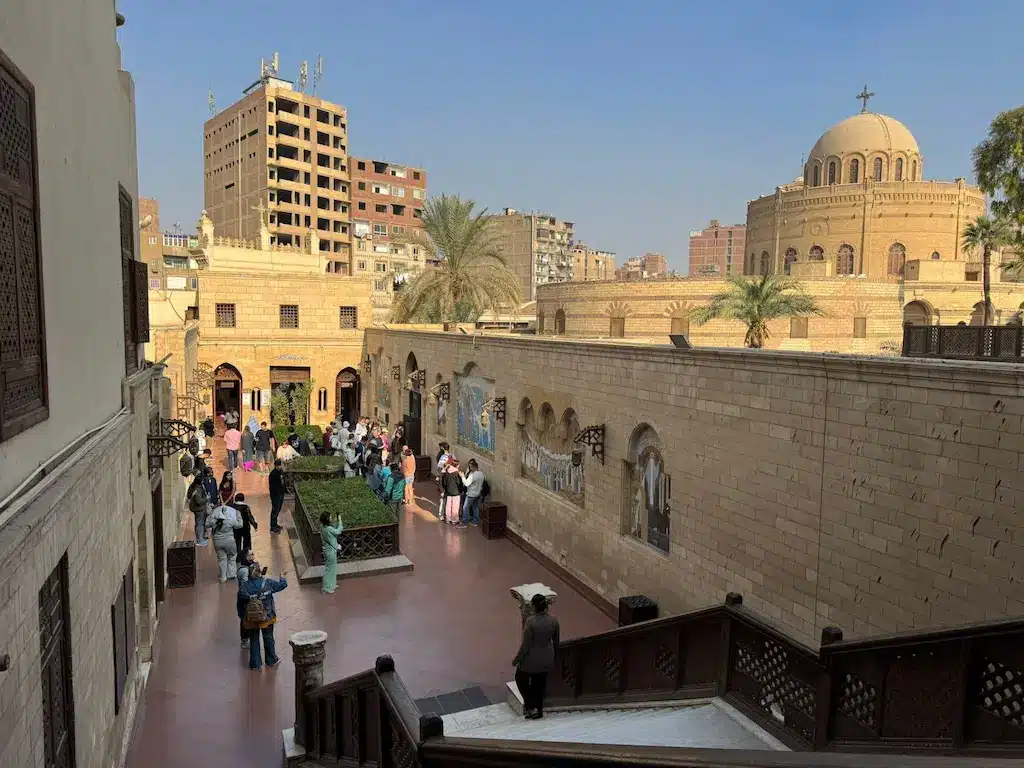
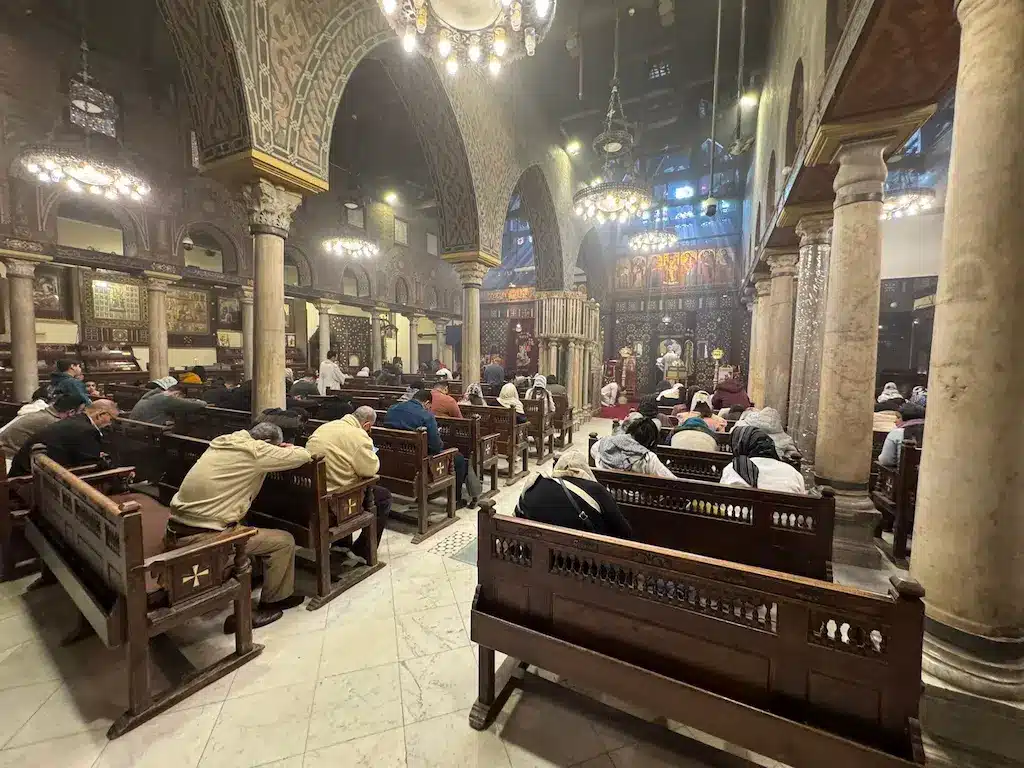
The most famous church in Coptic Cairo has a name that turns out to be literally descriptive. Al-Mu’allaqa means ‘the suspended one’ in Arabic — and the Hanging Church is called that because it was built directly on top of the southern gatehouse of the old Roman Babylon Fortress, suspended over two ancient Roman towers. When you stand in the nave and look down through the gaps in the floor, you are looking at stonework laid by Roman soldiers eighteen or nineteen centuries ago.
The church itself dates in its current form to the seventh century, though there has been a church on this site since at least the fourth century. It is dedicated to the Virgin Mary, and it served for many centuries as the seat of the Coptic Patriarch — the Pope of the Coptic Church — making it effectively the mother church of Egyptian Christianity during a significant portion of Christian history.
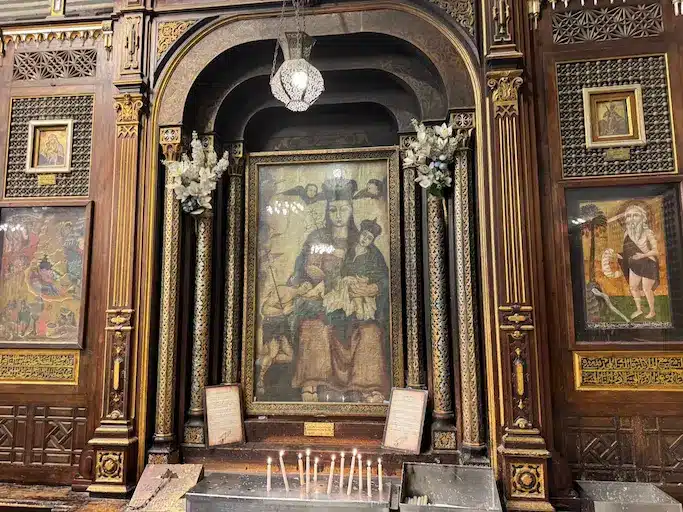
Step inside and give your eyes a moment to adjust. The interior is divided into three aisles by columns of marble and granite, their capitals carved in a variety of styles that suggest they were taken from earlier Roman and Byzantine buildings. The wooden iconostasis — the screen that separates the nave from the sanctuary — is one of the finest pieces of Coptic ecclesiastical woodwork in existence: inlaid with ivory in geometric patterns, dark with age, intricate beyond belief. The icons behind it are painted in the flat, frontal Byzantine style that feels simultaneously ancient and strangely modern.
Look up at the ceiling: it is shaped like an inverted boat hull, a form common in early Christian church architecture and one that carries its own symbolism — the church as the ark of salvation, the community of the faithful sailing through the world.
The Story of the Coptic Patriarch Who Died Rather Than Betray a Secret
The Hanging Church was the scene of one of the most dramatic episodes in Coptic Christian history. In the ninth century, the Abbasid Caliph Al-Ma’mun — curious about the legendary wealth of the Egyptian churches — demanded that the Coptic Patriarch reveal the location of the church’s hidden treasures. The Patriarch, a man named Joseph, refused. Al-Ma’mun had him tortured. Joseph still refused. The Caliph, reportedly both frustrated and impressed, eventually released him.
The church’s treasures were never found. Whether they existed as described in the legend, whether they were moved, or whether the story is a metaphorical account of spiritual endurance rather than a historical record, no one now knows. But the story has been told in the Hanging Church for over a thousand years, and it captures something real about the character of a community that learned, over centuries of minority status, to hold its most precious things quietly.
The Church of Saints Sergius and Bacchus — Abu Serga
A few minutes’ walk from the Hanging Church, down a narrow lane, Abu Serga is one of the oldest churches in Egypt — and the one with the most extraordinary claim attached to it.
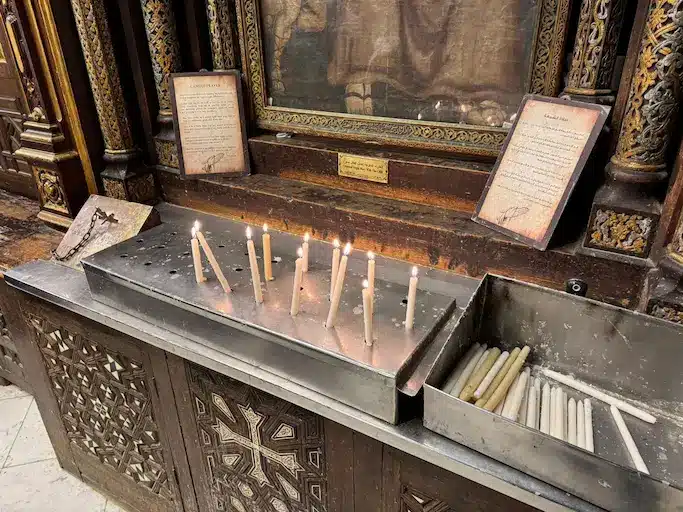
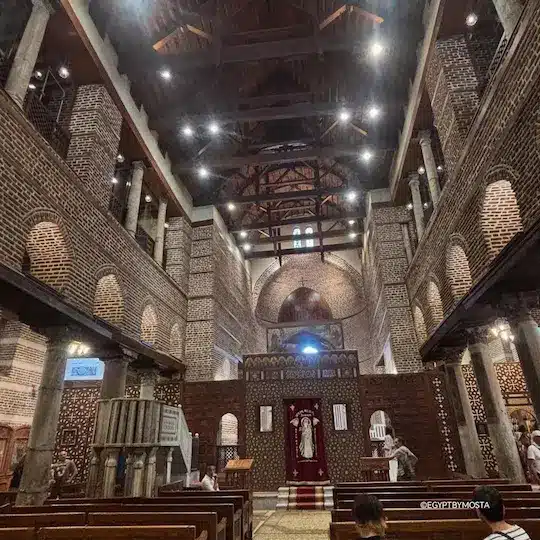
The church dates in its current form to the fourth or fifth century, though tradition holds that a place of worship has existed here since the first century AD. It is built in the basilica style — three aisles, a curved apse at the eastern end — and its columns are a mix of granite, marble, and limestone, almost certainly salvaged from earlier Roman buildings. The woodwork and icons are beautiful, though more worn than those in the Hanging Church.
But what draws pilgrims from around the world is what lies beneath the church: a crypt, accessed by a staircase to the left of the altar, which is venerated as the place where the Holy Family — Mary, Joseph, and the infant Jesus — sheltered during the Flight into Egypt. The crypt floods partially during the Nile inundation season, which has always been taken as evidence of its antiquity and its proximity to the ancient river level.
Standing in that small, low-ceilinged cave, with its ancient stone walls and its simple altar and the smell of incense that seems to have soaked into the rock over twenty centuries, is one of the more genuinely moving experiences available in Cairo — regardless of your personal religious convictions. Something very old is present in that space.
The Flight into Egypt — A Story Worth Knowing
The Coptic tradition of the Holy Family’s route through Egypt is remarkably detailed. According to the accounts preserved by the Coptic Church — drawing on early Christian texts, local oral tradition, and the writings of figures such as Theophilus, Patriarch of Alexandria in the late fourth century — the family entered Egypt through the Sinai, stayed in various locations along the Delta including the area of modern Cairo, then travelled south along the Nile as far as Upper Egypt before returning north and eventually leaving via Gaza.
The Abu Serga crypt is the most celebrated stopping point on this route. But across Egypt — in Matariya in northern Cairo, in Heliopolis, in Minya, in Assiut — dozens of sites claim associations with the Holy Family’s journey. The Coptic Church has formally designated many of these as a pilgrimage route, and Christian visitors increasingly travel Egypt following the path the family is said to have walked.
The Ben Ezra Synagogue
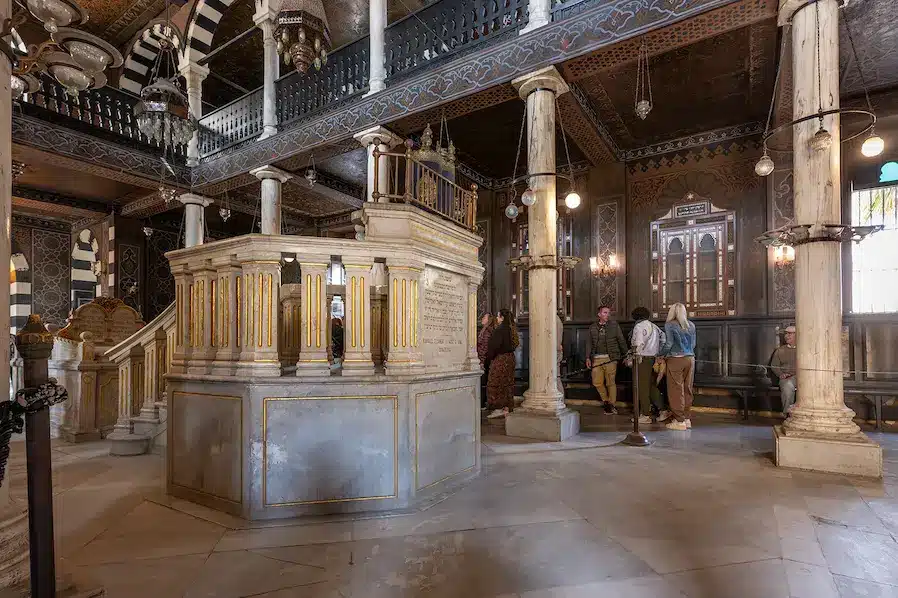
This one surprises people. In the heart of Coptic Cairo — a few steps from Abu Serga — stands one of the most historically significant synagogues in the world.
The Ben Ezra Synagogue is not primarily a religious site today; it functions as a museum. But its history is extraordinary. The building itself dates to the ninth century, built on the site of an even older church that the Coptic community sold to the Jewish community of Cairo when they needed funds to pay a tax to the Abbasid authorities. The synagogue is named after Abraham Ben Ezra, a twelfth-century Spanish rabbi who contributed to its renovation.
The Moses Story
Local tradition holds that the Ben Ezra Synagogue stands on the very spot where the daughter of Pharaoh found the infant Moses in a basket among the reeds of the Nile — a claim that requires some geographical imagination given how far the Nile has shifted over the millennia, but which has been embedded in local tradition for centuries and gives the site a significance that extends far beyond its architectural interest.
The Cairo Geniza — One of the Greatest Historical Discoveries in Modern Times
In 1896, a Scottish scholar named Solomon Schechter arrived at the Ben Ezra Synagogue and made one of the most extraordinary archival discoveries in modern history. In the geniza — a storage room where Jewish communities kept worn-out sacred texts that could not be destroyed because they contained the name of God — he found approximately 300,000 manuscript fragments accumulated over nearly a thousand years.
The Cairo Geniza, as it became known, contained letters, legal documents, business records, religious texts, and personal correspondence from the Jewish community of medieval Cairo and its trading connections across the Mediterranean and Indian Ocean worlds. Scholars are still working through the material today. It is, among other things, one of the most detailed pictures we have of everyday medieval life anywhere in the world — the prices of goods in a Cairo market in the eleventh century, the correspondence between merchants in Spain and their partners in India, the personal letters of ordinary people going about their lives in a city that was then one of the most cosmopolitan places on earth.
None of that is visible today when you stand in the beautiful, restored interior of the Ben Ezra Synagogue. But knowing it happened here adds something.
The Coptic Museum
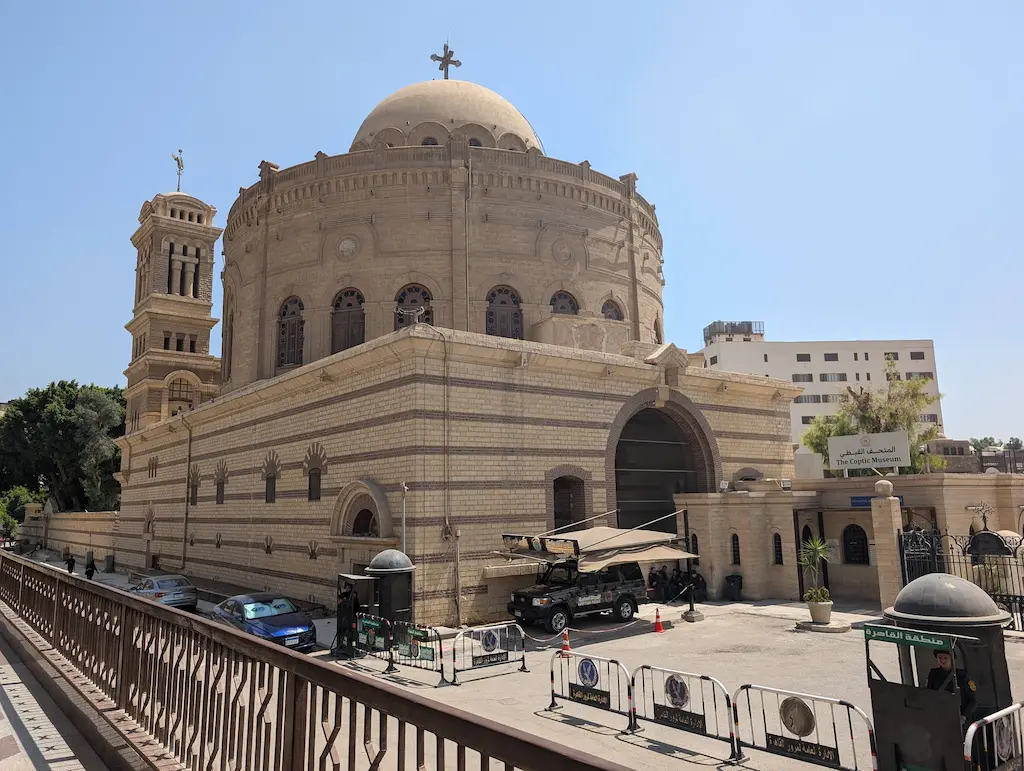
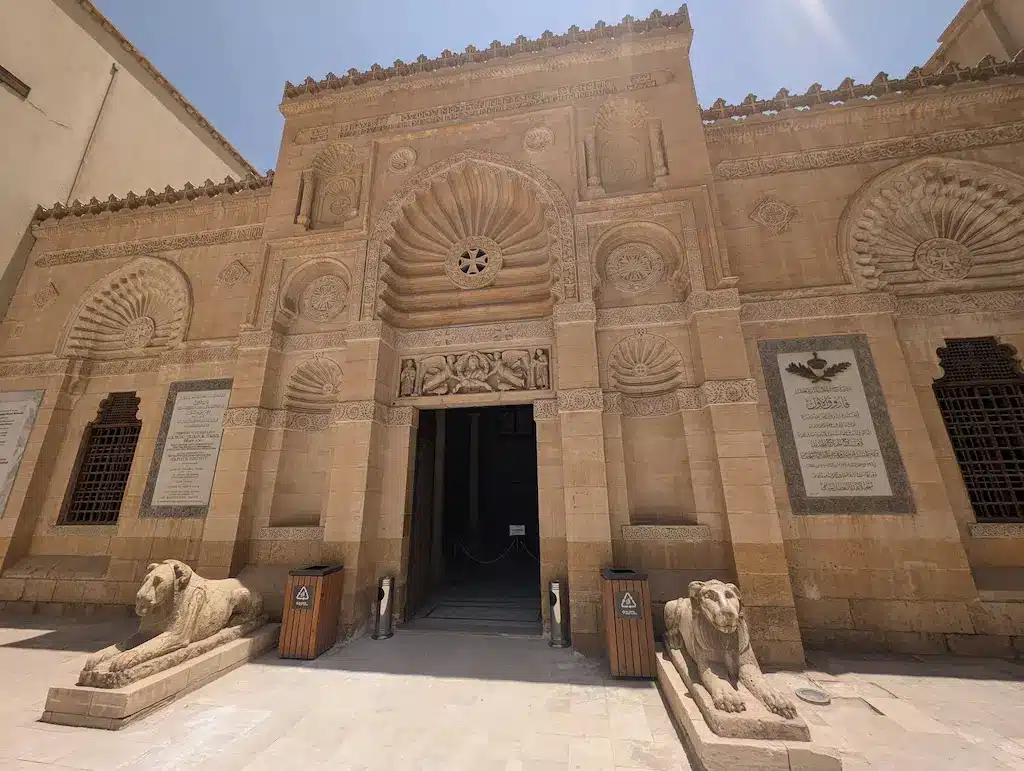
Founded in 1908 by the Coptic businessman and philanthropist Marcus Simaika, the Coptic Museum holds the world’s largest collection of Coptic Christian art and artefacts — approximately 16,000 objects spanning the period from the fourth century AD to the nineteenth.
The collection includes textiles of extraordinary refinement — Coptic weavers were among the finest in the ancient world, and their linen and wool hangings, with their vivid colors and intricate figurative designs, were traded across the Mediterranean. There are illuminated manuscripts, carved ivory, metalwork, frescoed plaster from early Christian chapels, wooden panels painted with the stylized, frontal faces of the Coptic icon tradition.
The building itself is worth the visit: it is a beautiful example of early twentieth-century Islamic Revival architecture, with carved wooden screens (mashrabiyya), painted wooden ceilings, and a garden courtyard that feels entirely peaceful after the energy of the surrounding streets.
Budget at least an hour here, more if you are seriously interested in the art and history. The museum is one of the most under visited institutions in Cairo — which means that on most mornings you will have much of it to yourself.
The Church of Saint Barbara
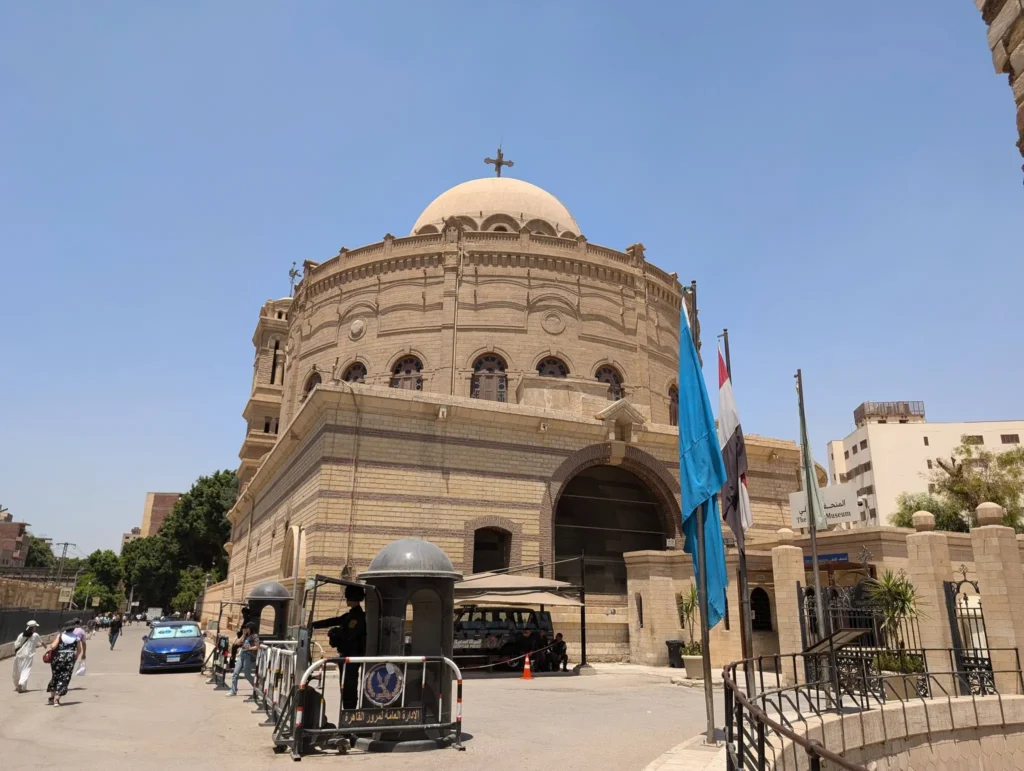
Just north of Abu Serga, the Church of Saint Barbara is one of the largest and most beautiful churches in Coptic Cairo. It is dedicated to Saint Barbara, a third-century Christian martyr from Asia Minor whose story — of a young woman imprisoned by her own father for converting to Christianity and eventually beheaded by him — is one of the most harrowing in the early Christian martyr ology.
The church dates to the fifth century and contains some of the finest medieval Coptic woodwork and ivory inlay in Egypt. Its sanctuary screen is particularly magnificent — a piece of craftsmanship that deserves as much attention as the more famous iconostasis of the Hanging Church.
The church also holds relics venerated as those of Saint Barbara and Saint Cyrus and John — two physicians who were martyred in the early fourth century and who are traditionally invoked for healing. On feast days, the church fills with worshippers seeking intercession for illness and hardship.
The Fortress of Babylon — The Roman Walls
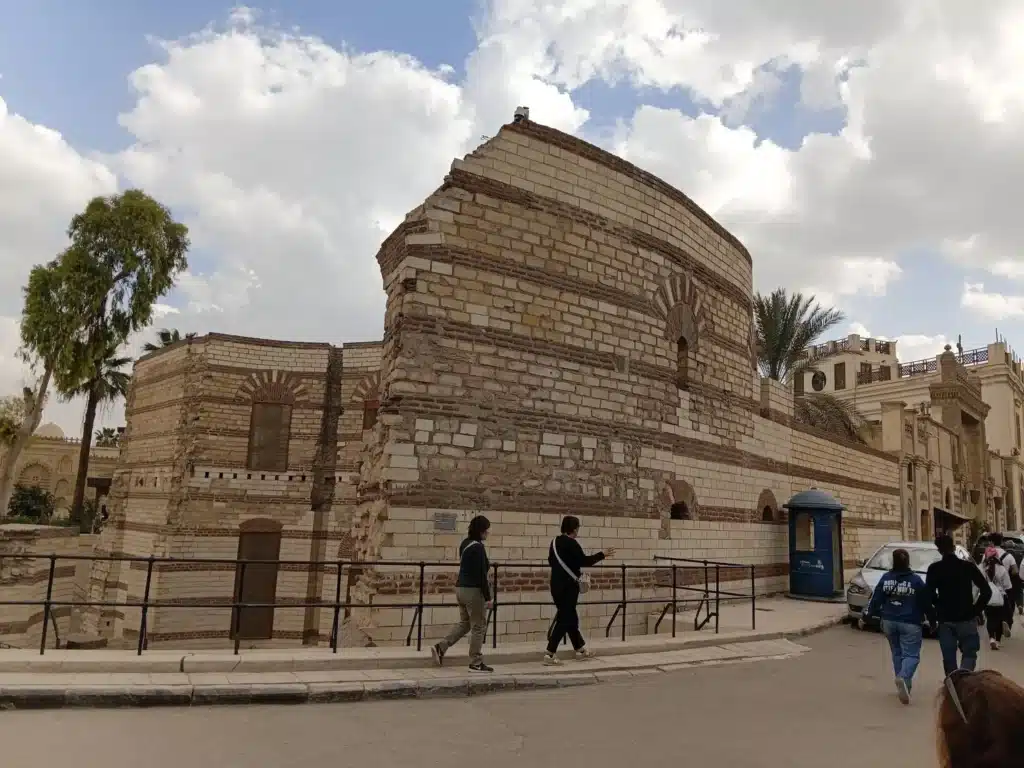
Before you leave Coptic Cairo, take a moment to look at what holds it all together: the ancient Roman walls of the Fortress of Babylon that still stand at the western edge of the compound. The two great round towers — built during the reign of the Emperor Arcadius in the early fifth century, on foundations that may be even older — rise from the ground near the Coptic Museum with a massiveness that is genuinely startling.
For a long time these towers were half-buried, with only their upper sections visible. Excavations in the twentieth century gradually exposed more of their original height. Today you can walk between them and look up at courses of Roman brick and stone that were laid sixteen or seventeen centuries ago, and understand something about the physical continuity that underlies the apparent chaos of Cairo — layer upon layer, culture upon culture, millennium upon millennium, all the way down.
3- Three Stories That Bring Coptic Cairo to Life
The Night the Library Was Saved
In the late nineteenth century, as the Ben Ezra Synagogue was being renovated, workers discovered the geniza room and began clearing it out — unaware of what it contained. Documents were sold to souvenir dealers, used as packing material, scattered to the winds. It was a near-catastrophe.
What saved the bulk of the collection was a woman named Agnes Smith Lewis, a Scottish scholar who visited Cairo in 1896 and heard rumours about the documents from dealers in the old Cairo bazaars. She and her twin sister Margaret had already made a name for themselves by discovering the oldest known Syriac manuscript of the Gospels in a monastery in the Sinai. Agnes alerted Solomon Schechter at Cambridge University, who came to Cairo, recognized what he was looking at, and negotiated to bring the bulk of the remaining material to Cambridge, where it is now housed in the Taylor-Schechter Geniza Research Unit.
The story of the geniza’s discovery is a detective story, a race against time, and a reminder of how close we come, again and again, to losing the evidence of the past.

How the Coptic Community Kept Its Identity for Two Thousand Years
The Coptic Orthodox Church has survived Roman persecution, the Diocletianic persecution of 303 AD (so savage that the Coptic calendar still begins its year from that date, called the Era of the Martyrs), the Arab conquest, the Crusades, the Ottoman period, and the turbulence of modern Egypt. Through all of it, the community maintained its language (Coptic, a direct descendant of ancient Egyptian written in a Greek-derived alphabet, is still used in the liturgy), its theology, its distinctive artistic tradition, and its sense of itself as the original church of Egypt.
The key was the neighborhood itself. Coptic Cairo — protected by the walls of the Babylon Fortress, organized around its churches, physically separate from the newer Islamic city that grew to the north — functioned as a kind of sanctuary. Generations grew up within its walls, married within its community, worshipped in its churches, buried their dead in its ground. The physical place preserved the community. The community preserved the faith. And the faith preserved the memory of who they were.
The Coptic Pope Who Stood Up to Napoleon
When Napoleon Bonaparte invaded Egypt in 1798, he made a point of presenting himself as respectful of Egyptian religion and culture — famously declaring that he and his army were friends of Islam. Less well known is his encounter with the Coptic community.
Napoleon initially tried to recruit the Coptic Patriarch, Pope Mark VIII, as an ally and intermediary with the Egyptian population. Pope Mark received French representatives politely and declined to actively collaborate. When the French occupation imposed heavy taxes on Egyptian Christians along with the rest of the population, Pope Mark led a quiet campaign of non-compliance. He died in 1809, during the period of French and then Ottoman-French conflict over Egypt, remembered by his community as a man who kept his dignity intact through a very complicated period of history.
4- Nearby Attractions: Building the Perfect Coptic Cairo Day
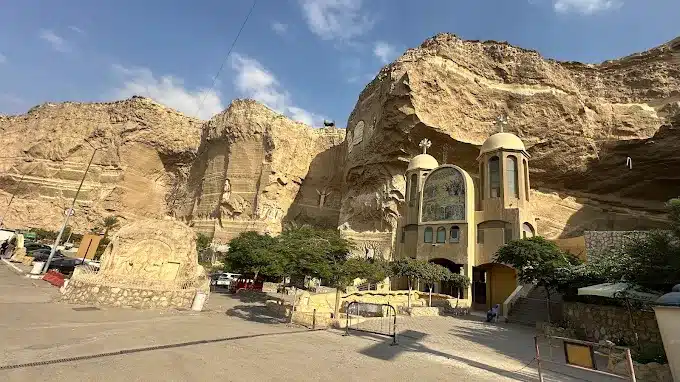
The Cave Church — Kanīsat al-Kahf (20 minutes by car)
No visit to the Christian heritage of Cairo is complete without the Cave Church — and the connection between Coptic Cairo and the Cave Church is more than geographical. Both sites are expressions of the same Coptic Christian community, separated in time and character but united in faith.
Where Coptic Cairo is ancient, layered, and intimate — a neighborhood of small churches and narrow lanes built over Roman ruins — the Cave Church is monumental, dramatic, and modern: a 20,000-capacity amphitheater carved from the limestone cliffs of the Mokattam Hills by and for the Zabaleen community of Garbage City. Visiting both in a single day gives you the full sweep of Coptic Christian life in Cairo, from its ancient roots to its living present. LuxeToursEgypt.com offers a Coptic Cairo and Cave Church combined tour that is one of our most popular private experiences.
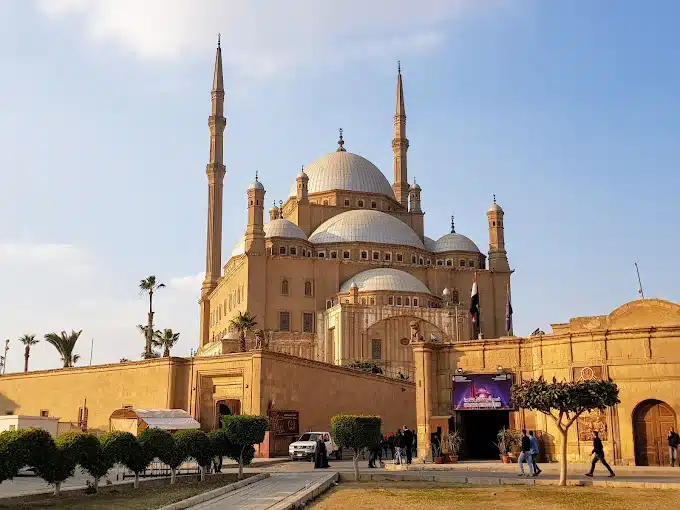
The Cairo Citadel and Islamic Cairo (20 minutes by car)
Coptic Cairo and Islamic Cairo are natural companions on a full Cairo day — two chapters of the same long story. After spending the morning in the Christian quarter, a short drive north takes you into the medieval Islamic city: the Sultan Hassan Mosque, the Cairo Citadel with the Alabaster Mosque of Muhammad Ali, and the Khan el-Khalili bazaar. The contrast between the quiet intimacy of the Coptic churches and the monumental grandeur of the Mamluk and Ottoman mosques is itself a kind of education in Cairo’s complexity.
Khan el-Khalili Bazaar and Al-Azhar (25 minutes by car)
The great medieval bazaar of Khan el-Khalili, trading continuously since 1382, and the Al-Azhar Mosque — founded in 970 AD and still one of the world’s great centers of Islamic scholarship — are a natural afternoon addition to a Coptic Cairo morning. Together they give you a day that begins in Roman-era Christianity and ends in medieval Islam, with the living city of Cairo in between.
The National Museum of Egyptian Civilization — NMEC (10 minutes by car)
The NMEC, opened in 2021 on the shores of Lake Ain El-Sira in Fustat — directly adjacent to Old Cairo — is one of the most impressive new museums in the Middle East. Its centerpiece is the Royal Mummies Hall, where 22 royal mummies of pharaonic Egypt are displayed in a setting of extraordinary dignity and care. The broader permanent collection traces 7,000 years of Egyptian history in beautifully designed galleries. Combining a morning in Coptic Cairo with an afternoon at the NMEC gives you an extraordinary sweep from the pharaonic world to the Christian era — two of Egypt’s deepest layers in a single remarkable day.
5- How Coptic Cairo Fits Into Your Cairo Itinerary
The Coptic Cairo Tour
A dedicated morning in Coptic Cairo — properly guided, with time to breathe and absorb — is one of the most rewarding experiences Cairo offers. A good itinerary starts at the Babylon Fortress towers, moves through the Hanging Church with time to sit in the nave and understand what you are looking at, continues to the Coptic Museum, then to Abu Serga and the crypt, then to the Ben Ezra Synagogue and the Church of Saint Barbara. That covers the essential sites without rushing and takes between two and a half and three hours.
Luxe Tours Egypt offers a private Coptic Cairo tour with an expert local guide who knows not just the facts but the stories — the ones that most guidebooks never find room for. It is the difference between visiting a neighborhood and understanding it.
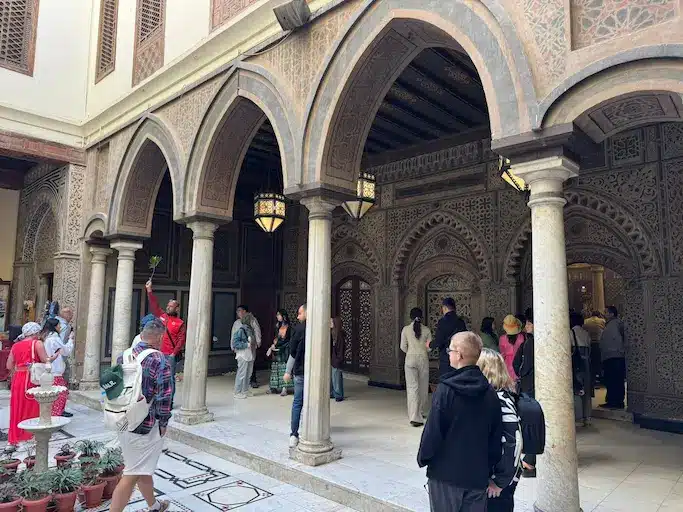
The Cairo Highlights Tour
For visitors with a single full day in Cairo who want to see the essential sweep of the city’s history, the Cairo Highlights Tour combines the Egyptian Museum, the Cairo Citadel and Alabaster Mosque, the NMEC, and Khan el-Khalili. Coptic Cairo can be added as a morning extension for visitors who begin early. Luxe Tours Egypt builds all of these itineraries as private, customized experiences — not group tours on fixed schedules, but days designed around what you actually want to see and how you want to see it.
Cairo Highlights Tour: Egyptian Museum, Citadel, NMEC & Khan El Khalili
6- The Complete Visitor’s Guide to Coptic Cairo
Getting There
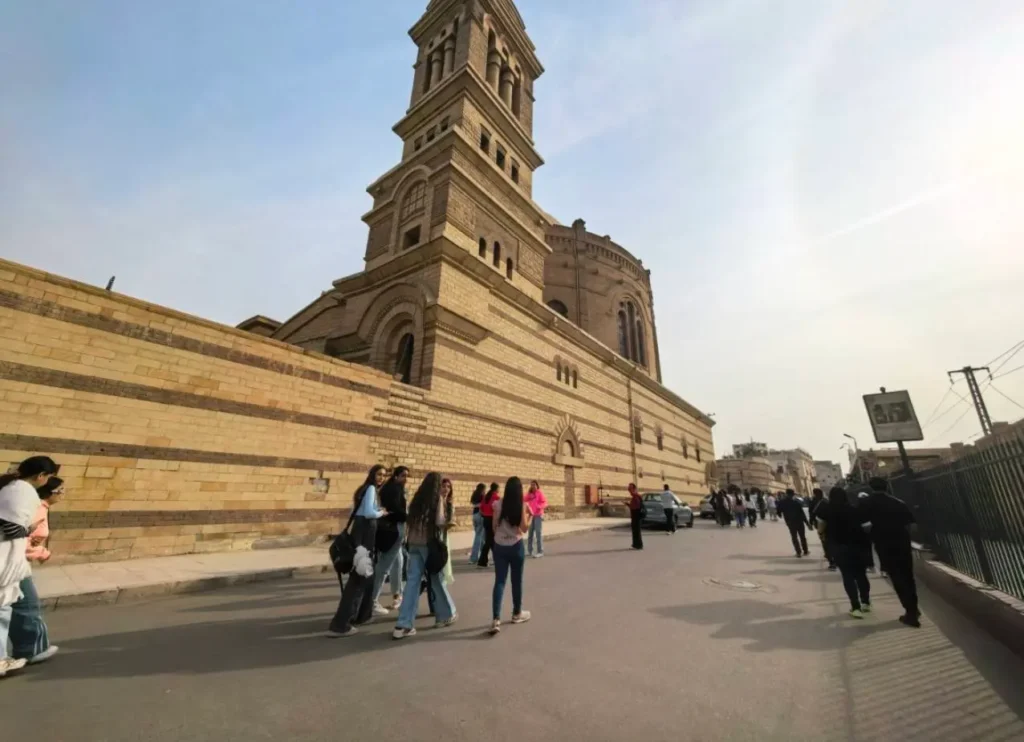
By Metro: Coptic Cairo has its own Metro station: Mar Girgis, on Line 1 (the red line). It is one stop south of Saad Zaghloul and one stop north of Al-Malik al-Saleh. The entrance to the Coptic Cairo compound is a 2-minute walk from the station — one of the easiest Metro connections in the city.
By Uber or Careem: Search for ‘Coptic Cairo’ or ‘Mar Girgis Church’ — both work well. From Downtown Cairo expect 15 to 25 minutes depending on traffic. Drop-off is on the main road adjacent to the compound entrance.
By guided tour: Luxe Tours Egypt provides door-to-door private pickup, allowing you to focus entirely on the experience rather than logistics.
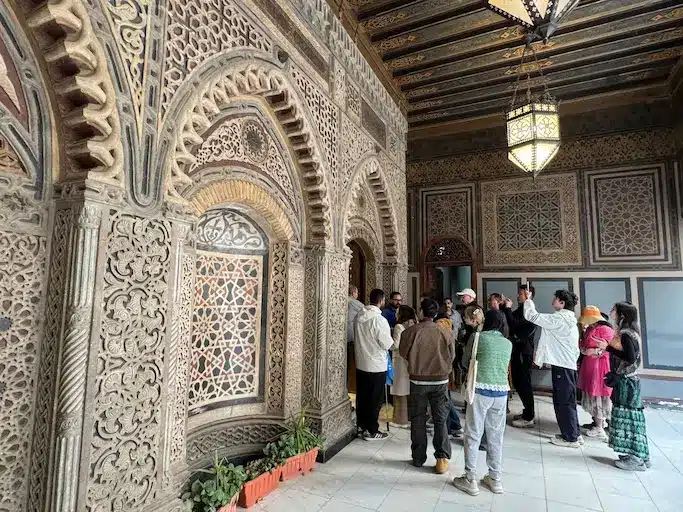
Opening Hours and Admission
Churches: Generally open daily from 9:00 AM to 4:00 PM. Individual churches may have slightly different hours and may be closed during services.
Coptic Museum: Open daily from 9:00 AM to 4:00 PM. There is an admission fee; cameras may require a separate ticket.
Ben Ezra Synagogue: Open daily from 9:00 AM to 4:00 PM.
Best arrival time: 9:00 AM on a weekday. The compound is at its quietest and most atmospheric in the first two hours of opening.
What to Wear
Coptic Cairo contains active churches and a synagogue, and modest dress is expected at all sites. Shoulders and knees should be covered for both men and women. Women may be asked to cover their hair before entering the prayer halls of some churches; a light scarf in your bag is always useful. Shoes remain on in Coptic churches and in the synagogue — this distinguishes them immediately from mosque visits, where shoes are removed.
How Long to Allow
The essential sites — Hanging Church, Abu Serga, Ben Ezra Synagogue, Coptic Museum, Church of Saint Barbara — take a minimum of two and a half hours when visited properly, without rushing. Three hours is more comfortable. Add another hour if you want to explore the Roman fortress towers and the surrounding streets.
Photography
Photography is generally permitted in the compound and in most of the churches, though you should always ask before photographing inside active services. The Hanging Church interior and the Abu Serga crypt are particularly photogenic. The Roman towers photograph well in the morning light. The Coptic Museum allows photography in most galleries.
7- Why Coptic Cairo Belongs at the Top of Your Cairo List
Most visitors to Cairo do not find this place. They see the Pyramids — as they should — and the Egyptian Museum and maybe the Khan el-Khalili bazaar, and they leave with a version of Cairo that is real but incomplete.
The version they miss is this one: the version where a Christian community has been praying in the same streets for two thousand years, where a cave beneath a Roman fortress is venerated as the shelter of the Holy Family, where a storage room in a synagogue turned out to contain the most important archive of medieval everyday life ever discovered, where you can stand between towers built by Roman soldiers and look up at walls that have been looking back at the Nile since before Islam existed.
Coptic Cairo is not dramatic in the way that the Pyramids are dramatic, or theatrical in the way that the Citadel is theatrical. It is quieter than that. It rewards attention and patience and the willingness to sit for a moment in a dim church that is older than most European countries and let the weight of it settle around you.
Bring a morning. Bring a good guide. And let one of the oldest Christian neighborhoods on earth show you something about Egypt that the guidebooks rarely reach.
When you are ready to experience it properly — with the context, the stories, and the depth it deserves — Luxe Tours Egypt is here to make it happen.
Quick Reference: Coptic Cairo at a Glance
Location: Mar Girgis district, Old Cairo, south of Downtown
Metro: Mar Girgis station, Line 1 (Red Line) — 2-minute walk to entrance
Opening Hours: Churches & Synagogue: 9:00 AM – 4:00 PM daily. Coptic Museum: 9:00 AM – 4:00 PM
Time Needed: 2.5–3 hours for all main sites; half-day recommended
Dress Code: Modest clothing. Shoulders and knees covered. Shoes stay ON in churches.
Best Photo Time: 9:00–11:00 AM for morning light in the compound
Combine With: Cave Church · Cairo Citadel · NMEC · Khan el-Khalili · Islamic Cairo
Best Tours: Coptic Cairo Tour · Cairo Christian Heritage Tour · Cairo Highlights Tour — Luxe Tours Egypt
Frequently Asked Questions
Is Coptic Cairo worth visiting?
Absolutely — and it is one of the most under visited major sites in Cairo, which means you will often have its streets and churches largely to yourself. It offers 2,000 years of history in a compact, walkable area and is unlike anywhere else in Egypt.
How do I get to Coptic Cairo?
The easiest option is the Cairo Metro: take Line 1 (Red Line) to Mar Girgis station. The entrance to the Coptic Cairo compound is a 2-minute walk. Uber and Careem also serve the area directly.
Can tourists visit the churches in Coptic Cairo?
Yes. All the churches and the Ben Ezra Synagogue are open to visitors of all faiths. Modest dress is required and you should be respectful of any services in progress, but tourists are genuinely welcomed.
What is the difference between Coptic Cairo and the Cave Church?
Coptic Cairo is the ancient Christian neighborhood in Old Cairo — home to the oldest churches in Egypt, the Coptic Museum, and the Ben Ezra Synagogue. The Cave Church (Kanīsat al-Kahf) is a modern church complex carved into the Mokattam Hills in eastern Cairo, built by the Zabaleen community from the 1970s onwards. They are separate sites but are often combined on a Cairo Christian Heritage Tour.
How much time should I spend in Coptic Cairo?
A minimum of two and a half hours to cover the essential sites properly. Three hours is more comfortable. A full morning — arriving at 9:00 AM and leaving around 12:30 PM — gives you time to see everything without rushing and to sit for a few minutes in the places that deserve it.
Is Coptic Cairo safe?
Yes. Coptic Cairo is one of the safest and most visitor-friendly areas of central Cairo. The compound is enclosed and calm, and the surrounding streets are quiet by Cairo standards. As with anywhere in a large city, normal awareness is sensible, but there is no particular safety concern associated with this area.