
What's Inside This Guide
If you’re flying into Egypt this year, there are two different visa-on-arrival processes, depending on which airport you land in. Cairo International Airport switched to a digital QR code system on 1 August 2026, as part of a pilot phase. The government has said the system will expand to other Egyptian airports in stages, though no dates have been confirmed yet. For travellers arriving directly at Hurghada, Sharm El Sheikh, Luxor, Marsa Alam, Aswan, or Alexandria, the QR-based process hasn’t been announced as operational, so the paper sticker remains the process to expect there for now.
Most of the guides floating around right now cover one system or the other, or blur the two together. That’s a problem: which one applies to you depends entirely on your arrival airport, and getting it wrong means turning up unprepared for a process that doesn’t exist at your gate.
I’ve seen a fair few forum threads already where someone’s turned up in Hurghada expecting a QR code system that simply isn’t there, or someone booking a Cairo flight assumes they can still just pay cash at a bank counter for a sticker like they did last time. Both mistakes are understandable. The announcement made headlines everywhere, and most of the coverage doesn’t spell out that it’s currently Cairo-only.
Here’s the quick version, then we’ll go through both processes properly.
Quick answer: which system applies to you?
| Airport | System in use |
| Cairo (CAI) | New, QR code (pilot phase) |
| Hurghada (HRG) | Paper sticker (not yet part of the QR pilot) |
| Sharm El Sheikh (SSH) | Paper sticker (not yet part of the QR pilot) |
| Marsa Alam (RMF) | Paper sticker (not yet part of the QR pilot) |
| Luxor (LXR) | Paper sticker (not yet part of the QR pilot) |
| Aswan (ASW) | Paper sticker (not yet part of the QR pilot) |
| Alexandria (HBE/ALY) | Paper sticker (not yet part of the QR pilot) |
The Egyptian Ministry of Tourism and Antiquities has confirmed this is a pilot phase, running at Cairo International Airport only for now. The system is scheduled to expand to other Egyptian airports in stages, though no date has been announced. If you’re heading straight to the Red Sea or Luxor, treat the QR code steps below as not yet relevant to you, and skip to the section on the paper sticker process.
If you’re landing in Hurghada, Sharm, Luxor, or anywhere except Cairo
Nothing has changed here yet. You’ll go through the same process travellers have used for years:
- After landing, look for the bank counters in the arrivals hall, before passport control. There are usually several: Banque Misr and National Bank of Egypt are the common ones.
- Pay the visa fee in cash. US dollars, euros, or pounds sterling are all accepted, though dollars tend to be the smoothest. Card payment isn’t available at these counters, so bring cash.
- You’ll be handed a paper visa sticker. Keep it loose, don’t fold it: an immigration officer needs to affix it into your passport.
- Join the passport control queue. The officer checks your passport, stamps it, and sticks the visa in.
That’s the whole process. It usually takes longer than the queue itself suggests, mostly because of the bank counter step, so budget extra time if you’re arriving on a busy flight or during peak season.
A couple of practical notes people tend to ask about: the sticker itself doesn’t specify an exit date, your entry stamp does, and it’s generally valid for a single entry for 30 days. And no, you can’t pre-arrange or pre-pay this one: the bank counter transaction has to happen in person, after you land.
If you’re landing in Cairo
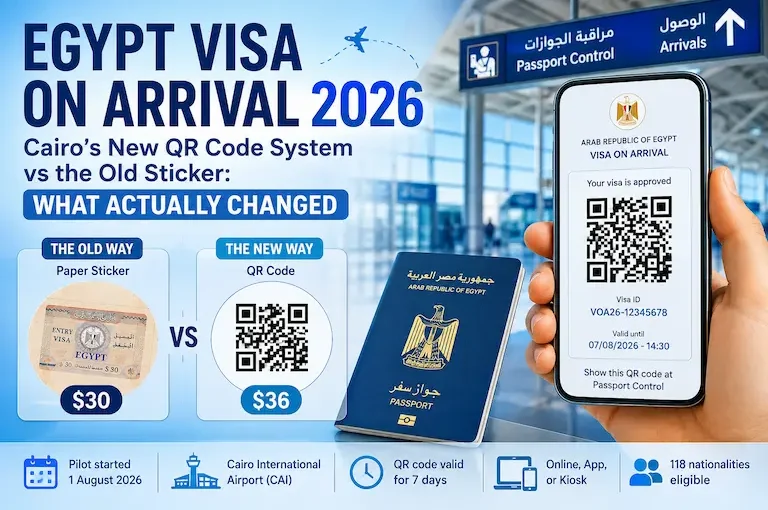
This is where it gets more involved. Cairo now has three ways to get your QR code, and during the pilot phase, the paper sticker isn’t used there for travellers who need a visa on arrival.
Option 1: Apply online before you fly
Go to the official portal at https://visaonarrival.gov.eg/home/landing, select your nationality and Cairo as your arrival airport, fill in your details, and pay electronically by Visa or Mastercard. You’ll receive your QR code by email. You can show it electronically on your phone or present a printed copy.
Option 2: Use the mobile app
The same service is available as an app, Visa on Arrival Egypt, on the App Store, Google Play, and AppGallery. It’s functionally the same process as the website, just on your phone. https://apps.visaonarrival.gov.eg/en/home.html
Option 3: Use the self-service kiosks at the airport
If you land without a QR code, there are self-service kiosks in the Cairo arrivals halls (Terminals 1, 2, and 3, plus the seasonal terminal) where you can complete the same application on the spot.
Online and app-based applications use electronic payment: the fee is $36 in total, made up of the existing $30 visa fee plus a new $6 charge for issuing the QR code, paid by Visa or Mastercard. During the pilot phase, cash payment is also available at designated bank counters if the traveller cannot obtain the QR code through the other channels. inside Cairo’s arrivals halls, though travellers who pay this way still receive a QR-based visa rather than a sticker. However you pay, the charge is non-refundable once your bank authorises it, even if you made a mistake on the form or your travel plans change. Double-check your details before you confirm.
Once you land, you don’t queue at a bank counter. You go straight to passport control and show your QR code, either on your phone or printed, for the officer to scan alongside your passport.
It’s also worth saying plainly that a QR code isn’t a guarantee of entry. It covers payment of the visa fee and gets your details into the system in advance. The passport control officer still makes the actual admission decision when you land, same as always. Nothing about that part has changed.
Cairo vs everywhere else, side by side
| Cairo (pilot) | All other airports | |
| Format | QR code | Paper sticker |
| Fee | $36 total | $30 (cash) |
| Payment | Electronic by default; cash may be available during the pilot | Cash only |
| Can apply before arrival | Yes, up to 7 days before use/arrival | No |
| Physical document in passport | No | Yes |
| Validity of the QR/application | 7 days from issue | N/A |
That validity window matters if you’re applying in advance: get your Cairo QR code too early and it can expire before you land, especially with delays or a rescheduled flight. Apply close to your actual travel date, not weeks out.
Who’s actually eligible, and how this differs from the e-Visa
None of this changes who can get a visa on arrival in the first place. Egypt has announced that citizens of 118 nationalities are eligible for a visa on arrival, based on a mix of security, tourism, and reciprocity criteria. Because eligibility can change, travellers should verify their own nationality through the official visa system before travelling, rather than assuming based on this figure alone.
If your nationality isn’t currently eligible for a visa on arrival, you may need to obtain a visa in advance through the appropriate Egyptian visa channel, whether that’s the e-Visa portal, an embassy or consulate, or another process specific to your nationality.
And that’s the other point worth being precise about: the Digital Visa on Arrival is not the same thing as Egypt’s e-Visa. They’re two separate systems.
- e-Visa: applied for and approved before you travel, through the official e-Visa portal. You get a decision in advance, and you’re not paying anything at the airport.
- Digital Visa on Arrival (the new Cairo system): still a visa-on-arrival process at its core. You’re not getting pre-approval. You’re paying the same fee you’d pay at the airport, just electronically, and getting a QR code instead of a sticker. Egyptian border officers still make the final call on entry when you land, whichever version you used.
If you’d rather have your visa sorted and approved before you even board your flight, the e-Visa is the one to look at, not the Cairo QR system, despite how similar the names sound.
What if you’re flying into Cairo, then connecting to Hurghada or Luxor?
This trips a lot of people up, and it’s worth being precise about how it works.
If Cairo is where you complete Egyptian immigration before continuing on a domestic flight to Hurghada, Luxor, or elsewhere, your visa-on-arrival procedure is handled at Cairo, using the QR system, even though your final destination is somewhere else. You’d clear immigration in Cairo, then continue to your connecting flight as a domestic passenger.
If instead you’re flying direct into Hurghada, Sharm, or one of the other resort airports without touching Cairo at all, you’re on the paper sticker process the whole way, with no QR code involved.
Check whether your itinerary includes an Egyptian domestic connection after your first international arrival. That first arrival point, not your final destination, is what determines which visa process applies to you.
Common mistakes to avoid
- Assuming the QR system applies everywhere already. It’s currently limited to Cairo, with expansion to other airports planned in stages but not yet scheduled. If you’re not landing in Cairo, applying for a QR code in advance won’t do anything for you at your actual arrival airport.
- Applying for your Cairo QR code too far in advance. It expires seven days after issue. Do it close to departure, not a month out.
- Not bringing cash for a non-Cairo arrival. Card machines at the bank counters in resort airports are unreliable at best. US dollars are the safest bet.
- Confusing this with the e-Visa. If you want your visa fully sorted before you fly, with no airport step at all, that’s the e-Visa, not the Cairo QR system, which is still a visa-on-arrival process.
- Not checking your connection routing. If Cairo is your first landing point, even briefly, you’re on the QR system for that leg, regardless of your final destination.
Need Help With Your Egypt Trip?
Visa rules and arrival procedures can sometimes be confusing, especially when a new system is being introduced. If you are unsure about your arrival procedure, need help planning your airport transfer, or would like assistance arranging your Egypt trip, Luxe Tours Egypt is here to help.
You can contact us on WhatsApp
FAQ
Is the paper visa sticker gone completely?
At Cairo International Airport, the new QR-based system has replaced the paper-sticker process for current Visa on Arrival issuance. The QR system is still being rolled out in stages, so travelers arriving at other Egyptian airports should check the procedure applicable to their airport.
How much does the Cairo QR visa cost?
$36 in total: the $30 visa fee plus a $6 issuance charge.
Can I still pay cash at Cairo?
During the pilot phase, yes. Cash payment is available at the bank counters in the Cairo arrivals hall, though you’ll still be issued a QR code rather than a sticker. This could change once the pilot phase ends.
How long is the QR code valid before I travel?
Seven days from the moment it’s issued.
Do I still need to go through passport control?
Yes, at every airport, under both systems. The QR code doesn’t replace passport control. It replaces the sticker you’d otherwise present there.
What if I land in Cairo without a QR code?
You can apply on the spot using the self-service kiosks in the arrivals hall, with support staff nearby if you need help.
Can travel agencies arrange the QR code for clients?
Yes, tour operators can apply on behalf of their clients. If you’re travelling with a private guide or tour company, it’s worth asking whether they’ll handle this step for you.
Will this system reach Hurghada or Sharm El Sheikh soon?
The Ministry of Tourism and Antiquities has said expansion to other airports will happen in stages, but no date has been set. For now, plan around the paper sticker if you’re heading to the Red Sea coast.
Arriving in Hurghada instead?
Read our complete guide Hurghada Airport Visa on Arrival 2026
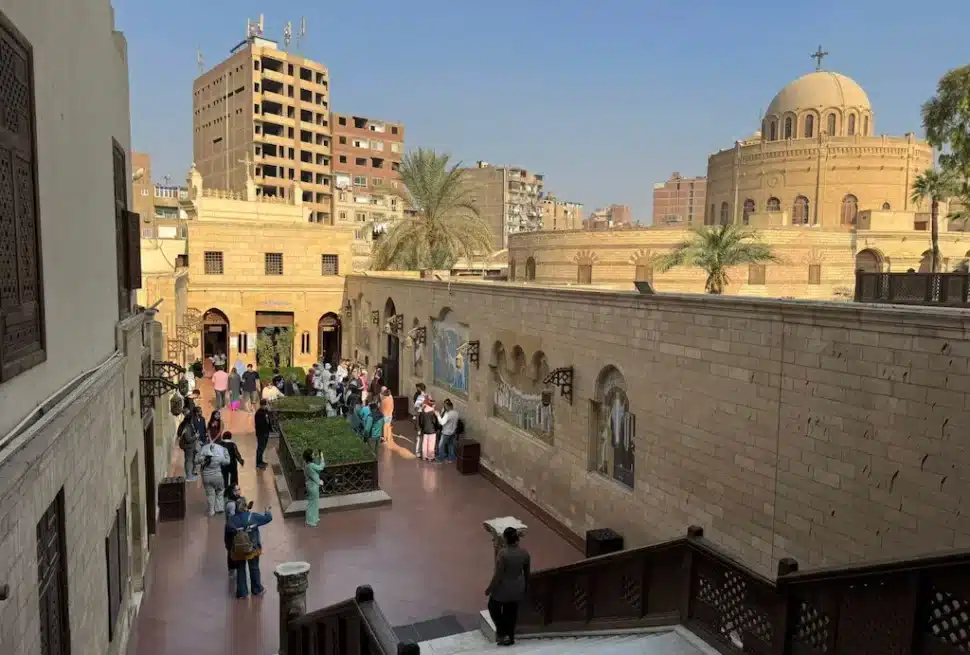


[…] Read our complete guide to Egypt’s new Digital Visa on Arrival system at Cairo Airport, including how it compares with the traditional process still used at Hurghada and other airports. egypt-visa-on-arrival-2026/ […]