
The Complete Guide to Saladin’s Fortress and the Mosque of Muhammad Ali
What's Inside This Guide
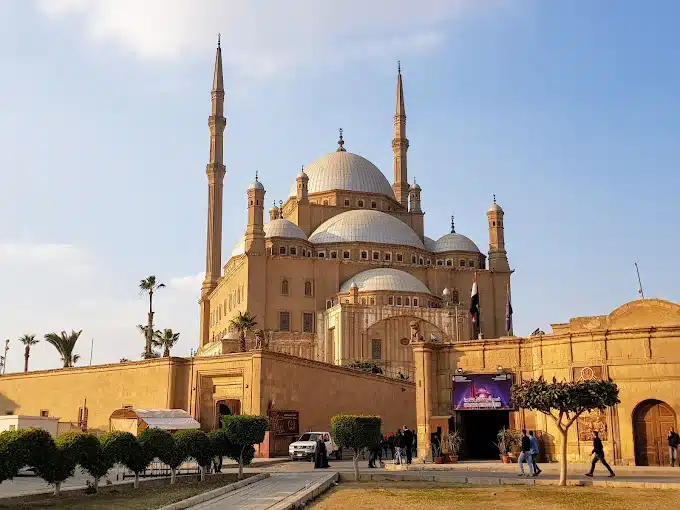
There is a moment, somewhere on the road from Downtown Cairo heading east toward the Mokattam Hills, when the city opens up and you see it: a fortress rising from the rock on the horizon, its two slender minarets cutting the sky like needles, the great dome of the mosque glowing pale and enormous in the Egyptian light.
That is your first look at the Cairo Citadel — and it has been stopping people in their tracks for 850 years.
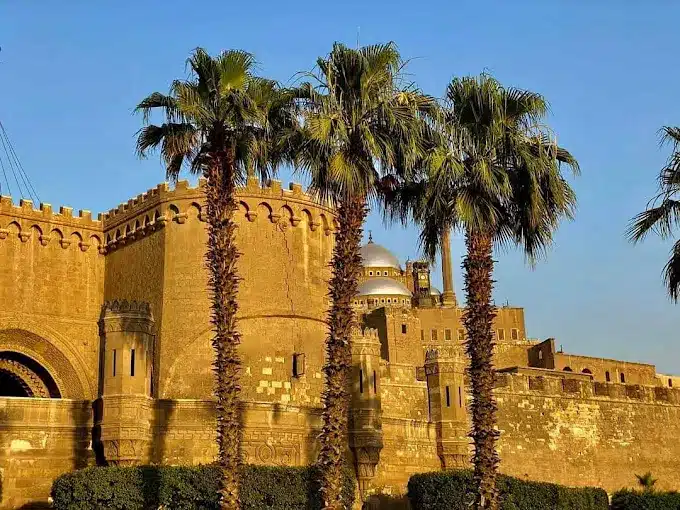
Built by Saladin, the legendary warrior-sultan who united the Muslim world against the Crusaders, the Citadel of Saladin sits on a natural spur of the Mokattam Hills at the eastern edge of medieval Cairo. For seven centuries, it was the seat of power in Egypt — the place where every ruler from Saladin to the Ottoman sultans to Muhammad Ali Pasha made their home, issued their decrees, and shaped the destiny of a nation. Today it remains one of the most visited landmarks in Cairo, and rightly so: nowhere else in the city offers such a combination of history, architecture, stories, and views.
At its heart stands the Mosque of Muhammad Ali — known worldwide as the Alabaster Mosque — one of the most dramatic pieces of Islamic architecture in Africa. Walk inside and you will understand immediately why it stops people cold.
This guide covers everything: the history, the stories you will not find in most guidebooks, what to see, how to visit, how to combine it into a perfect Islamic Cairo day tour, and what else is nearby. If you are planning a trip to Egypt, keep reading.
1- The Cairo Citadel: 850 Years of History on One Hill
Why Saladin Built It Here
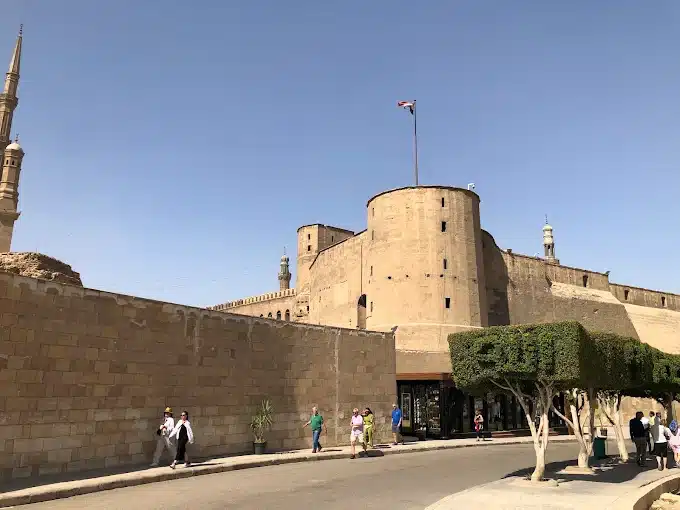
In 1176, Saladin — Salah ad-Din Yusuf ibn Ayyub, Sultan of Egypt and Syria, the man who would go on to recapture Jerusalem from the Crusaders — made a strategic decision that would define Cairo’s skyline forever. He ordered the construction of a great fortified citadel on the spur of the Mokattam Hills.
The choice of location was brilliant. The spur rose sharply above the flat city, offering commanding views in every direction. An enemy approaching from any angle would be visible long before they arrived. The rock itself provided natural fortification on three sides. And critically, a deep well — the famous Bir Yusuf, or Well of Joseph — could be dug through the bedrock to provide a reliable water supply in case of siege. Saladin’s engineers cut that well over 85 metres through solid limestone. It is still there, and you can still see it today.
“Saladin chose this hill not for the view — though the view is extraordinary — but because a ruler who controls the high ground controls everything below it.”
Saladin himself never actually lived in the Citadel he built. He spent most of his reign campaigning — against the Crusaders in Palestine and Syria, against rival Muslim rulers who challenged his authority, against the instability that had plagued the region for generations. The Citadel he designed was completed after his death in 1193, and it was his Ayyubid successors who first made it the permanent seat of Egyptian power.
Seven Centuries of Rulers
What followed is one of the great continuities of Middle Eastern history. For nearly 700 years — from the Ayyubids through the Mamluks and into the Ottoman period — every ruler of Egypt lived and governed from the Citadel of Saladin. Think about that for a moment: every decree, every war, every treaty, every execution, every celebration that shaped the fate of Egypt between 1200 and the early 1800s originated in these walls.
The Mamluks — the warrior-slave dynasty that replaced the Ayyubids in 1250 and produced some of the most extraordinary soldiers and patrons of Islamic art in history — left their mark all over the Citadel. The beautiful Al-Nasir Muhammad Mosque, built between 1318 and 1335, stands as one of the finest examples of Mamluk religious architecture remaining in Egypt. Walk past its striped marble columns and carved stone portal and you are walking past the aesthetic achievement of a dynasty that built the most sophisticated Islamic civilisation of the medieval world.

The Story of the Massacre of the Mamluks — The Citadel’s Darkest Day
Every great historic site has its darkness, and the Citadel’s is particularly vivid. It happened on March 1, 1811, and it is known in Egyptian history as the Massacre of the Mamluks.
By 1811, the Mamluks had been nominally defeated but remained a powerful and dangerous force in Egyptian politics. Muhammad Ali Pasha, the Ottoman-appointed governor who was in the process of turning himself into an independent ruler of Egypt, decided that they had to be eliminated entirely. He invited their leaders — somewhere between 470 and 500 Mamluk beys and their entourages — to a celebratory procession and banquet at the Citadel to honour the appointment of his son Tusun as commander of a military expedition to Arabia.
The Mamluks arrived in their finest dress, riding their horses through the narrow road that wound down through the Citadel’s gates. Muhammad Ali’s soldiers were waiting in the towers and on the walls above. At a signal, the gates were closed — trapping the entire Mamluk procession in a narrow defile. The soldiers opened fire from above.
According to the most famous account of the massacre, only one Mamluk escaped: a bey named Amin Bey, who spurred his horse toward the edge of the Citadel’s fortifications and leapt — horse and rider together — over the wall and down the steep drop to the ground below. The horse died from the fall. Amin Bey survived, wounded, and rode to safety. It is the kind of story that sounds like legend but is attested by contemporary witnesses.
By the end of that March afternoon, the Mamluk aristocracy of Egypt had ceased to exist. Muhammad Ali was effectively the undisputed master of the country. He would spend the next four decades transforming Egypt into a modern state — and building, as his monument, the mosque that bears his name.
2- The Mosque of Muhammad Ali: Egypt’s Most Dramatic Interior
Why It Is Called the Alabaster Mosque
Muhammad Ali Pasha began construction of his great mosque in 1830, and it was not completed until 1848 — two years before his death. He wanted something that would announce Egypt’s modernity, its ambition, and his own legacy. He wanted, in short, something that looked nothing like anything that had come before it in Egypt.
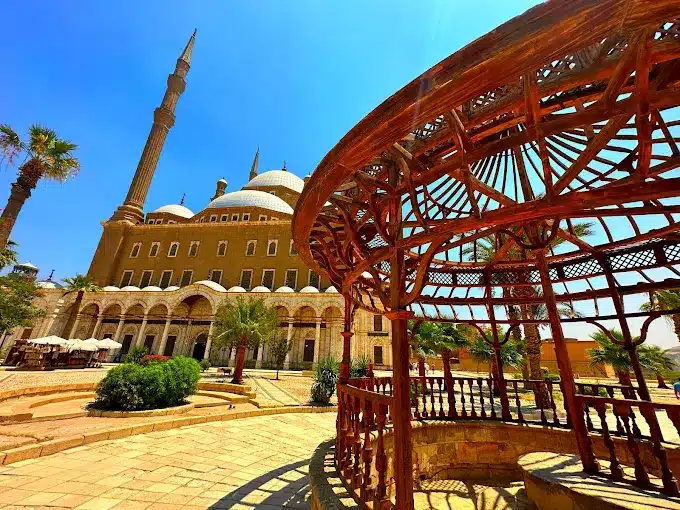
He hired Yusuf Boshnak, an Ottoman architect trained in the imperial tradition of Istanbul, and instructed him to build something worthy of the great Ottoman mosques of the capital. The result was a building unmistakably inspired by the Hagia Sophia and the Blue Mosque of Istanbul — a great central dome surrounded by four smaller semi-domes, flanked by two pencil-thin minarets rising 84 metres into the Cairo sky.
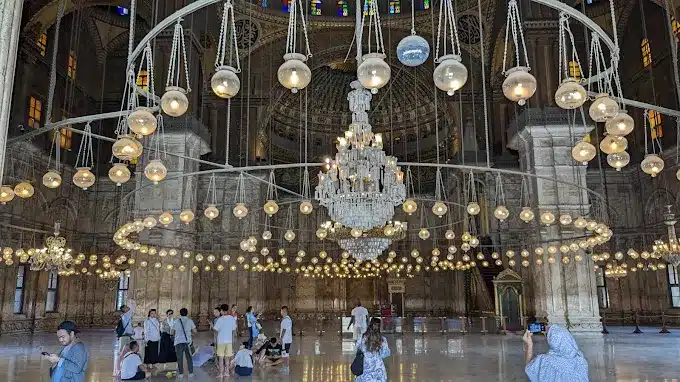
The mosque gets its popular name from the material that covers almost every surface of its lower walls: alabaster — the translucent, cream-coloured stone quarried from the cliffs near Beni Suef in Upper Egypt. In daylight, the alabaster panels glow softly, as if lit from within. At certain times of day, the light coming through the mosque’s hundreds of lamps and windows turns the interior into something between a cathedral and a dream.
“Step inside the Alabaster Mosque on a quiet morning and you understand, without anyone having to tell you, why people build beautiful things to hold their prayers.”
The French Clock That Never Works
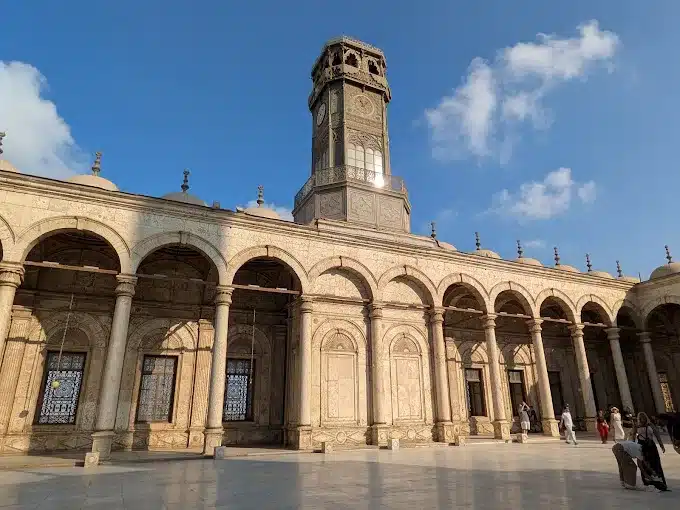
Standing in the mosque’s outer courtyard, you will notice a large ornate clock tower on the western side. It was a gift from King Louis-Philippe of France in 1845, sent in exchange for the obelisk that Muhammad Ali gave to France — the obelisk now known as the Luxor Obelisk, which has stood in the Place de la Concorde in Paris since 1836.
Here is the thing about the clock, and the thing that Egyptians will tell you with a mixture of amusement and irritation: it has almost never worked. It was reportedly broken during transit from France, repaired, and then stopped working again. Over 175 years, it has been repaired multiple times and has consistently failed to keep reliable time. The obelisk in Paris, needless to say, is in perfect condition and is one of the most admired monuments in France.
It is, depending on your perspective, either a pleasing historical irony or a minor diplomatic embarrassment that has lasted nearly two centuries. Visitors photograph the clock tower constantly, most of them unaware of its story.
The Tomb of Muhammad Ali
Muhammad Ali Pasha is buried in the mosque he built. His white marble tomb is enclosed behind an ornate grille in the southwestern corner of the prayer hall — a space of striking calm within the grandeur of the larger interior. The tomb is simple by the standards of the building around it, which is perhaps fitting: Muhammad Ali was a man of enormous ambition and considerable brutality who also, undeniably, dragged Egypt into the modern world. He built schools, a military academy, factories, irrigation systems, and a navy. He sent Egyptian students to Europe on government scholarships. He is regarded in Egypt as the founder of modern Egypt — a complicated legacy for a complicated man.
The View from the Courtyard
Before you go inside, spend time in the outer courtyard. From here, on a clear day, you can see the Pyramids of Giza on the western horizon — three ancient triangles floating above the haze of the city, roughly 20 kilometres away. It is one of the most extraordinary juxtapositions in all of Cairo: standing in the courtyard of a 19th-century Ottoman mosque on a medieval fortress, looking across a 21st-century megalopolis at monuments that are 4,500 years old.
This view is also, incidentally, one of the best spots for photography in all of Cairo. Arrive early, before the tour buses, and you will have the courtyard largely to yourself.
3- What Else Is Inside the Citadel
The Al-Nasir Muhammad Mosque
Do not let the grandeur of the Alabaster Mosque make you rush past this one. The Al-Nasir Muhammad Mosque, built by the Mamluk Sultan Al-Nasir Muhammad ibn Qalawun between 1318 and 1335, is one of the finest surviving examples of Mamluk religious architecture in Egypt. Its striped marble columns were taken from earlier buildings — some brought from as far as the Crusader church at Acre. Its stone portal is exquisitely carved. It is smaller and quieter than the Muhammad Ali Mosque, and for that reason often more moving.
The Gawhara Palace
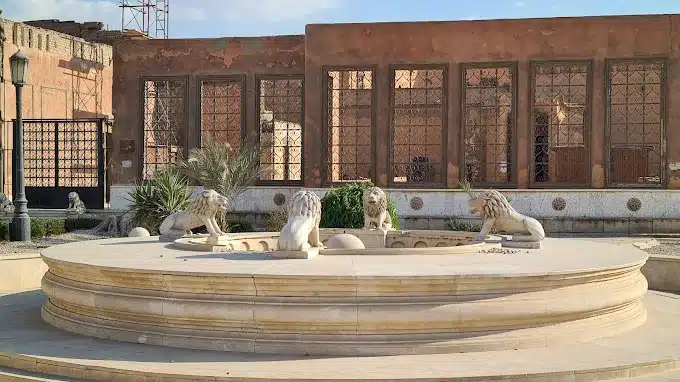
The Gawhara (Jewel) Palace was built by Muhammad Ali in 1814 as his personal residence within the Citadel. It now serves as a museum and gives visitors a rare look at the domestic life of Egypt’s 19th-century ruling class — rooms furnished in the Ottoman-European hybrid style of the period, with gilded ceilings, French furniture, and Orientalist paintings. It was in this palace that Muhammad Ali received foreign dignitaries, signed treaties, and planned the elimination of the Mamluks.
The National Military Museum
Housed in the former Harem Palace of Muhammad Ali, the National Military Museum traces the history of Egypt’s armed forces from the ancient pharaonic period to the modern era. The building itself is impressive — a grand 19th-century structure with painted ceilings and ornate halls. The exhibits include weapons, uniforms, maps, and dioramas of famous battles. History enthusiasts and those with an interest in military history will find it genuinely rewarding.
The Panoramic Terrace
At the northern end of the Citadel complex, a terrace offers what many consider the single best panoramic view in all of Cairo. Below you, the medieval city of Islamic Cairo spreads out in its entirety — a forest of minarets, domes, and centuries-old streets. To the south, the Sultan Hassan Mosque and the Mosque of Ibn Tulun are clearly visible. To the west, beyond the Nile, the Pyramids wait on the horizon. Few places in the world offer such a concentrated panorama of human history.
4- Nearby Attractions: Building Your Perfect Islamic Cairo Day
The Cairo Citadel sits at the geographical and spiritual heart of Islamic Cairo — one of the largest surviving medieval Islamic cities in the world and a UNESCO World Heritage site. Everything around it is extraordinary, and combining these sites into a single day gives you one of the richest cultural experiences available anywhere on earth.
Sultan Hassan Mosque and Madrassa (5-minute walk)
Directly below the Citadel’s main entrance, visible from the panoramic terrace above, the Sultan Hassan Mosque is widely regarded as the greatest masterpiece of Mamluk architecture anywhere in the world. Built between 1356 and 1363 during the reign of Sultan Hassan ibn Muhammad ibn Qalawun, it is a building of almost overwhelming scale and refinement. The entrance portal alone — 38 meters high, framed by two enormous minarets — is one of the most dramatic entrances in Islamic architecture. Inside, the courtyard is vast and serene, the proportions perfect, the stone carving extraordinary.
Budget at least 45 minutes here. It is the kind of building that reveals itself slowly.
Al-Rifa’i Mosque (directly opposite Sultan Hassan)
Standing directly opposite Sultan Hassan across a wide square is the Al-Rifa’i Mosque — built between 1869 and 1912 and containing the tombs of several members of the Egyptian royal family, including King Farouk, the last king of Egypt, who died in exile in Rome in 1965 and was repatriated for burial here. Also buried here, in a gesture of extraordinary historical significance, is Shah Mohammad Reza Pahlavi of Iran — the last Shah, who died in Cairo in 1980 after being granted asylum by President Anwar Sadat. History moves through this building in surprising ways.
The Blue Mosque — Mosque of Aqsunqur (10-minute walk)
Often missed by visitors who do not know to look for it, the Mosque of Aqsunqur is known as the Blue Mosque for the magnificent Turkish faience tiles that cover its interior walls — brought from Damascus and installed in the 17th century. The contrast between the blue-and-white tiled interior and the medieval stone exterior is genuinely startling. On a quiet morning, it is one of the most beautiful spaces in Cairo.
Khan el-Khalili Bazaar and Al-Azhar (20-minute walk)
The great medieval bazaar of Khan el-Khalili has been trading continuously since 1382 and remains one of the most atmospheric markets in the world. Gold, spices, perfume, textiles, antiques, souvenirs, and the specific quality of organised chaos that only a very old city can produce. Pair it with a visit to Al-Azhar Mosque — founded in 970 AD and one of the oldest universities in the world — and you have a morning that most visitors to Cairo simply never find.
Ibn Tulun Mosque (15-minute walk)
Built in 876–879 AD, the Ibn Tulun Mosque is the oldest mosque in Cairo to survive in its original form, and at 26,000 square metres it is also the largest in the city. Its famous spiral minaret — unique in Cairo and reminiscent of the great minaret of Samarra in Iraq — is one of the most distinctive architectural silhouettes in the Middle East. Combine it with the extraordinary Gayer-Anderson Museum, a beautifully preserved 17th-century mansion immediately adjacent, and you have added another two hours of extraordinary material to your day.
5- How the Citadel Fits Into Your Cairo Itinerary
The Islamic Cairo Tour
The Citadel is the natural anchor and climax of any Islamic Cairo tour. A well-designed Islamic Cairo day starts in the morning at Ibn Tulun Mosque, works north through the winding lanes of the historic Fatimid city past Al-Azhar and Khan el-Khalili, and arrives at the Citadel in the early afternoon — by which point the morning light is perfect for the Alabaster Mosque’s courtyard and the panoramic views from the terrace.
Luxe Tours Egypt offers a private Islamic Cairo tour with an expert local guide – Islamic Cairo Tour who has spent years studying this part of the city. It is not just a walk past monuments — it is a journey through a thousand years of Cairo’s history, told through the buildings and streets that shaped it. Book it as a standalone experience, or combine it with other Cairo highlights.
The Cairo Highlights Tour
For visitors who want to see the broadest sweep of Cairo in a single day — the Egyptian Museum, the Citadel, the National Museum of Egyptian Civilization, and Khan el-Khalili — the Cairo Highlights Tour is the most efficient and satisfying way to do it. Start your morning at the Egyptian Museum with its extraordinary collection of pharaonic treasures, then head to the Citadel as the light begins to climb and the city spreads out below you.
From there, the National Museum of Egyptian Civilization takes you on a sweeping journey through 7,000 years of Egyptian history in one of the most beautifully designed museums in the Middle East. End your afternoon losing yourself in the medieval lanes of Khan el-Khalili — Cairo’s great bazaar, trading continuously since 1382.
Cairo Highlights Tour: Egyptian Museum, Citadel, NMEC & Khan El Khalili
It sounds like a lot. Done properly, with the right guide and a well-paced itinerary, it is not exhausting — it is exhilarating. You move from the age of the pharaohs to the age of the sultans to the living, breathing Cairo of today, all in the course of one remarkable day.
6- The Complete Visitor’s Guide to the Cairo Citadel
Getting There
By Uber or Careem: Enter ‘Cairo Citadel’ or ‘Saladin Citadel’ — every driver knows it. From Downtown Cairo expect 15 to 25 minutes; from Giza about 35 to 45 minutes depending on traffic. Drop-off is at the main entrance on Salah Salem Road.
By taxi: Tell the driver ‘Al-Qal’a’ (القلعة) — the Arabic name all drivers recognise. Agree on a fare before you set off.
By tour: The simplest and most rewarding option. Luxe Tours Egypt provides private door-to-door pickup with an expert guide, handling all logistics so you can focus entirely on the experience.
Opening Hours and Tickets
Opening hours: Daily 8:00 AM to 4:00 PM. Last entry is typically at 3:00 PM.
Best arrival time: 9:00 AM on a weekday. The morning light in the Alabaster Mosque courtyard is spectacular, the crowds are thin, and you have time to explore without rushing.
What to Wear
The Cairo Citadel contains active mosques, and modest dress is required. Women should cover their hair when entering the prayer halls — a light scarf in your bag is essential. Shoulders and knees should be covered for both men and women. You will be asked to remove your shoes before entering the prayer halls. Comfortable walking shoes are strongly recommended for the uneven stone surfaces throughout the complex.
How Long to Allow
A thorough visit to the Citadel alone — the Alabaster Mosque, the Al-Nasir Muhammad Mosque, the panoramic terrace, and a look at the Gawhara Palace — takes a minimum of two hours. Allow three if you want to visit the Military Museum and explore without rushing. Combined with Sultan Hassan and Al-Rifa’i below, budget a full half-day.
Photography Tips
The best light for the Alabaster Mosque courtyard is early morning (before 11:00 AM) and late afternoon (after 3:30 PM). The interior of the mosque is dim but beautiful; a phone camera on portrait mode or a camera with a wide lens works well. The panoramic terrace is best photographed in the early afternoon when the western horizon — where the Pyramids are — is lit from the front. Dusk from the terrace, if you time it right, is one of the great photography opportunities in Cairo.
7- Why the Cairo Citadel Belongs on Every Egypt Itinerary
There is a version of a Cairo trip where you see the Pyramids, the Sphinx, and the Egyptian Museum, and you go home satisfied. Those are extraordinary things and they deserve every minute you give them.
But the Citadel shows you a different Egypt — the Egypt of the medieval sultans and the Crusader wars, of the Mamluk horsemen and the Ottoman domes, of a ruler who invited his enemies to a party and locked the gates, of a French clock that has never told the right time, of a view from a fortress wall where you can see 4,500 years of human ambition laid out across a single horizon.
That is a lot of history for one afternoon. And somehow, standing in the courtyard of the Alabaster Mosque as the light changes and the muezzin calls from the twin minarets above you and the Pyramids hover on the western horizon, it all makes perfect sense.
Come and see it for yourself. And when you are ready to explore it properly — with context, with stories, with someone who knows this city deeply — Luxe Tours Egypt is here to make it happen.
Quick Reference: Cairo Citadel at a Glance
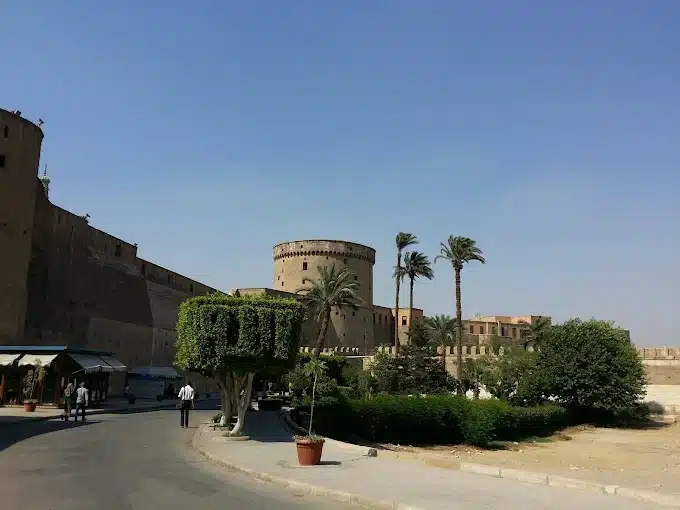
Location: Mokattam Hills, Eastern Cairo (Salah Salem Road)
Opening Hours: Daily 8:00 AM – 4:00 PM
Time Needed: 2–3 hours for Citadel alone; half-day with nearby mosques
Dress Code: Modest clothing. Women cover hair in mosques. Remove shoes in prayer halls.
Best Photo Time: Early morning for the mosque interior; afternoon for Pyramids view from terrace
Getting There: Uber/Careem: search ‘Cairo Citadel’. 15–25 min from Downtown Cairo.
Combine With: Sultan Hassan Mosque · Al-Rifa’i Mosque · Khan el-Khalili · Ibn Tulun · Al-Azhar
Best Tour: Islamic Cairo Tour or Cairo Highlights Tour — Luxe Tours Egypt
Frequently Asked Questions
Is the Cairo Citadel worth visiting?
Absolutely. The Citadel offers a combination of extraordinary Islamic architecture, panoramic views over Cairo (including the Pyramids), and 850 years of history in one site. It is one of the most rewarding half-days you can spend in Egypt.
Can non-Muslims visit the Muhammad Ali Mosque?
Yes. The Mosque of Muhammad Ali — the Alabaster Mosque — is open to all visitors regardless of faith. Modest dress is required and shoes must be removed before entering the prayer hall.
How do I get from the Cairo Citadel to the Pyramids of Giza?
The Pyramids are approximately 35 to 50 minutes from the Citadel by Uber or taxi, depending on traffic. Many visitors combine both in a single day on a Cairo Highlights Tour.
What is the difference between the Cairo Citadel and Islamic Cairo?
The Cairo Citadel is a specific fortress complex — one landmark within the broader area of Islamic Cairo. Islamic Cairo refers to the entire medieval district surrounding the Citadel, including the Khan el-Khalili bazaar, Al-Azhar Mosque, Sultan Hassan Mosque, and dozens of other historic sites. The Citadel is the best starting point for exploring the whole area.
Is a guide necessary for the Cairo Citadel?
A guide is not strictly necessary but makes an enormous difference. The Citadel is rich with stories — the massacre of the Mamluks, the French clock, the story of Muhammad Ali’s rise to power — that you will simply not encounter without someone to tell them. A knowledgeable guide turns a pleasant afternoon into an unforgettable one.



[…] Citadel of Saladin […]